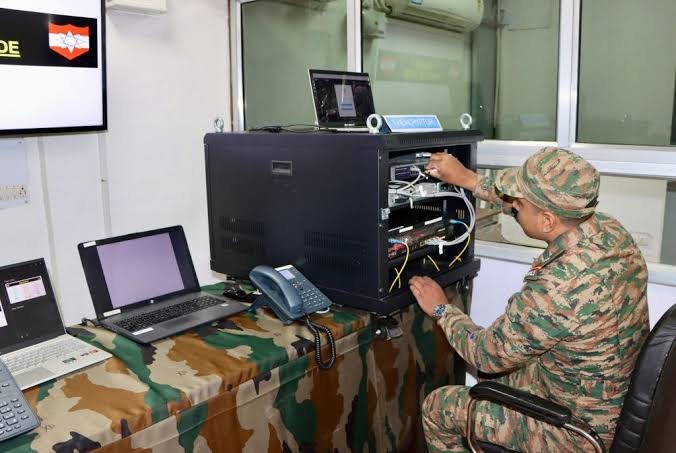
With the successful completion of military field trials of an indigenous fiber-based Quantum Key Distribution (QKD) system by Bangalore-based Taqbit Labs and DRDO, India has made significant progress in secure defense communications.
This innovation sets the groundwork for a scalable multi-hop quantum-secure network for India’s armed forces and guarantees defense against next-generation cyberthreats, such as attacks from upcoming quantum computers.
Together with Taqbit Labs, the Defense Research and Development Organization (DRDO) has transformed quantum cryptography from lab tests into a robust, combat-ready system.
In order to protect India’s strategic communication networks from adversaries using “harvest now, decrypt later” strategies—in which encrypted data is intercepted now with the intention of decrypting it once quantum computing matures—a fiber-based QKD system was demonstrated during military field trials.
QKD makes use of the basic principles of quantum mechanics, in contrast to classical encryption, which depends on mathematical complexity. Quantum states cannot be measured or replicated without changing them, according to the No-Cloning Theorem.The Defense Sector
The quantum particles are quickly disturbed by any attempt at interception, corrupting the key and instantly warning operators. This renders compromised keys unusable prior to the transmission of any sensitive data and makes eavesdropping detectable.
Temperature variations and signal deterioration across commercial fiber lines are examples of environmental stressors that the system has been designed to tolerate. The hardware may be deployed in operational military contexts since Taqbit Labs and DRDO have made sure it is durable and tamper-evident. The development of quantum security for national defense has advanced significantly as a result.
One of the steepest challenges in quantum networking is distance, as quantum signals degrade over fibre after several dozen kilometres. DRDO’s breakthrough lies in its scalable multi-hop architecture, which chains secure nodes together to extend communication links across vast distances. This architecture paves the way for building a large-scale quantum communication grid capable of connecting command centres, radar stations, and critical military infrastructure.
The trials mark a significant advancement in India’s National Quantum Mission, which seeks to develop independent quantum technologies in the fields of encryption, sensing, and communication. By accomplishing this feat, India strengthens its strategic autonomy and digital sovereignty and places itself among the few countries equipped to implement quantum-secure military networks.
This accomplishment has ramifications not only for defense but also for finance, energy, and other crucial industries where quantum-safe communication is essential. India can grow its quantum-secure backbone to safeguard national infrastructure against changing cyberthreats thanks to the system’s scalability.
With DRDO and start-ups like Taqbit Labs leading efforts to lessen dependency on foreign technologies, this achievement demonstrates India’s expanding ecosystem of domestic quantum research. It also shows how private deep-tech companies and defense research can work together to advance sovereign capabilities.
India’s preparedness to operationalize quantum-secure communication networks and ensure resilience against the cyber challenges of the quantum age is confirmed by the QKD system’s successful military field trials.