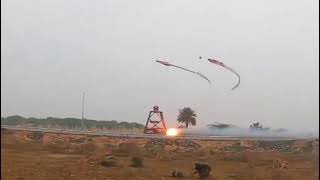
In order to develop the deceleration system of the Gaganyaan Crew Module, ISRO successfully finished a series of qualification tests for Drogue Parachutes at the Rail Track Rocket Sled (RTRS) facility of the Terminal Ballistics Research Laboratory (TBRL), Chandigarh, on December 18–19, 2025.
Ten parachutes of four different kinds make up the Gaganyaan Crew Module’s deceleration system. Two drogue parachutes, which stabilize and slow down the module, come after two apex cover separation parachutes, which remove the parachute compartment’s protective cover.
Three pilot parachutes are used to extract three main parachutes when the drogues are released, further slowing down the Crew Module to guarantee a safe landing.
The deployment of drogue parachutes, which are essential for both stabilizing the Crew Module and lowering its velocity to a safe level during re-entry, is a key part of this system.
This particular test series’ goal was to thoroughly assess the drogue parachutes’ dependability and performance in harsh environments.
On December 18 and 19, 2025, the RTRS tests on drogue parachutes were successfully carried out, meeting all test objectives and demonstrating their resilience in the face of notable fluctuations in flying conditions.
With active support and involvement from the Vikram Sarabhai Space Centre (VSSC), ISRO, Aerial Delivery Research and Development Establishment (ADRDE), DRDO, and Terminal Ballistic Research Laboratory (TBRL), DRDO, the successful completion of these tests represents another important step toward qualifying the parachute system for human spaceflight.