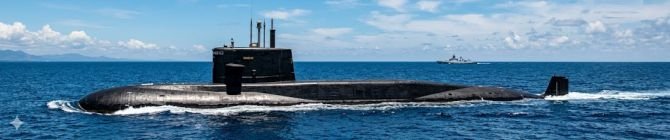
A key component of India’s strategic posture, sea-based deterrence has changed the country’s defense strategy in an increasingly unstable geopolitical environment. This change emphasizes how important it is to have a survivable second-strike capability, especially as adversaries investigate vulnerabilities in several domains.
In this equation, China is a significant factor. An ongoing challenge to intelligence gathering is China’s growing presence in the Indian Ocean, which is demonstrated by research ships, survey ships, and dual-use technological platforms.
These resources undermine India’s operational secrecy by tracking submarine movements, mapping underwater terrain, and collecting acoustic signatures.
China’s naval growth, particularly its growing fleet of nuclear-powered ballistic missile submarines (SSBNs), exacerbates this problem. In order to preserve regional security, Beijing’s underwater armament now patrols far-off waterways, necessitating a reliable Indian counterforce.
Submarine-launched ballistic missiles (SLBMs) such as the K-4 and K-5 are key components of India’s response. These missiles can penetrate Chinese defenses and restore strategic balance when fired from the Bay of Bengal. No part of China’s heartland is inaccessible thanks to their range, which is over 3,500 km for the K-4 and possibly 5,000 km for the K-5.
Sea-based deterrence is made more urgent by the Pakistan factor. With marine skirmishes intensifying alongside land and air operations, Operation Sindoor in May 2025 demonstrated the reality of a naval component in Indo-Pakistani wars. The dangers of coalition-enabled escalation were brought to light by Pakistan’s mid-conflict alliances with Turkey and Azerbaijan, including purported transfers of cutting-edge naval technologies.
These partnerships highlight the need for multi-domain deterrence strategies. An undersea nuclear trio is necessary to discourage adventurism on land, in the air, and at sea because India’s surface fleet was exposed to asymmetric threats during Sindoor.
This requirement is further intensified by contemporary combat. The 2025 West Asian conflict, which featured US-Israeli bombings on Iran, demonstrated how air campaigns can take on naval aspects. The Strait of Hormuz quickly turned into the epicenter, paralyzing global energy flows with missile barrages, drone swarms, and mines.
In modern battles, domain boundaries are porous, as actions in one theater might set off a chain reaction in another. Therefore, in order to provide complete protection against hybrid threats, deterrence must simultaneously cover all domains, from cyber breaches to subterranean attacks.
India’s defense self-reliance aspect is at the core of its development. The SSBN program represents the height of technological sovereignty and is one of the country’s greatest achievements in domestic manufacture.
These vessels, which were designed and built under great secrecy at the Ship Building Centre in Visakhapatnam, mark a significant advancement in domestic capability. Each component of the reactor, sensor, and weld is the result of years of meticulous ingenuity by Indian engineers.
This effort lessens reliance on Russia, India’s long-standing defense supplier, whose supply channels are stretched due to the current conflict in Ukraine. Due to production bottlenecks, battlefield casualties, and sanctions, foreign procurement has become unreliable, driving New Delhi toward self-sufficiency.information on India’s defense
The SSBN project supports India’s Aatmanirbhar Bharat vision in defense, which is the hardest area to indigenize because it combines propulsion technologies, stealth materials, and nuclear physics. Benefits from success here spread throughout the industry.
Additionally, it establishes the engineering and industrial framework for the SSN (nuclear assault submarine) program, which is expected to be completed by 2036. This next stage will be accelerated by shared hull designs, reactor knowledge, and supply chains, allowing hunter-killer operations to destroy enemy carriers and submarines.
However, there are still significant obstacles. Allocating resources is still a constant challenge: balancing SSN development, SSBN upgrades, and conventional navy modernization puts a strain on limited funds. Ruthless financial discipline is required to prioritize subsurface nuclear forces without sacrificing frigates, destroyers, and amphibious assault ships.
Another challenge is integrating technology. As China leads the world in AI-driven sonar avoidance, predictive maintenance, and unmanned undersea vehicles, integrating AI and autonomous systems into submarine design and operations is crucial. In order to prevent technological obsolescence, India needs to close this gap.
Human capital requirements are presented via crew and operational readiness. Excellent training streams are necessary for nuclear submarine operations in order to handle weapons, run silently, and conduct extended underwater patrols. It will take consistent funding for academies, simulators, and psychological resilience initiatives to scale this knowledge across the country.
As the arsenal grows, it becomes increasingly difficult to maintain no-first-use (NFU) credibility. To avoid misunderstandings, especially in the face of rising tensions, it is crucial to send clear signals to adversaries through patrols, missile testing, and doctrine reiterations.
The disparity with China is still very noticeable. With more than 70 vessels, including cutting-edge Yuan-class diesel-electric and Type 096 SSBNs, the People’s Liberation Army Navy (PLAN) has a far larger submarine fleet than India. Parity is a long way off, requiring asymmetric advances like networked sensing and quieter propulsion.
INS Aridhaman is more than just a new ship; it makes a strategic statement. This 6,000-ton monster, which is powered by an 83 MW pressurized water reactor and equipped with K-4 missiles, represents the evolution of India’s nuclear deterrence from a limited, land-centric posture to a resilient, multi-domain architecture.
The ability to threaten intolerable punishment from below the sea is essential at a time when conflicts start in one domain and quickly spread to others—whether from cyberattacks cascading to blockades or drones cueing missile salvos. Underwater impunity is crucial because adversaries are contesting the Indian Ocean more and more, from Gwadar to the Malacca Strait.
The challenges ahead include commissioning indigenous SSNs for offensive punch, integrating AI into submarine operations for godlike situational awareness, and achieving continuous at-sea deterrent with several SSBNs on perpetual patrol. These achievements require constant commitment and resources.
However, the direction is clear. INS Aridhaman ensures that any aggressor considers the abyss before attacking, marking a turning milestone in India’s journey towards true nuclear second-strike legitimacy.