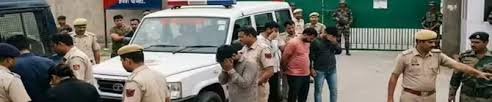
An interstate network engaged in terrorism, arms smuggling, and espionage has been successfully dismantled by the Delhi Police’s Special Cell. The network was allegedly led by handlers in Pakistan and the Inter-Services Intelligence.
This clandestine module installed solar-powered CCTV cameras close to important military locations throughout Rajasthan and Punjab, creating a sophisticated surveillance system, according to an official statement issued on Friday.
The breakthrough followed two coordinated strikes that led to eleven people being taken into custody. A larger scheme connected to the outlawed organization Babbar Khalsa International has been revealed by the probe. The reconnaissance of vital defense installations and the smuggling of weapons, which directly and seriously jeopardize India’s national security, were the main topics of this module.information on India’s defense
At least nine solar-powered cameras with SIM cards had been set up by the suspects in strategically important locations, police discovered. These devices were positioned in locations where Army and paramilitary personnel frequently move. Alwar and Bikaner in Rajasthan, Ambala in Haryana, Kathua in Jammu and Kashmir, and Moga, Patiala, Pathankot, Jalandhar, and Kapurthala in Punjab were among the places targeted.
Pramod Singh Kushwah, Additional Commissioner of Police, emphasized that these regions are high-security zones because of their close proximity to international borders, as well as the existence of significant Army cantonments and logistical routes. The module sent real-time video feeds straight to handlers in Pakistan using mobile applications and SIM cards that were obtained using false identities.
According to reports, handlers headquartered in Pakistan were directly in charge of the operators, who coordinated their actions through encrypted communication systems. Their main responsibilities included keeping an eye on troop movements and taking comprehensive pictures of different defense facilities to send across the border.
In order to maintain surveillance in remote locations without conventional power supplies, solar power was purposefully used, making the equipment far more difficult to detect. Such technological complexity, according to the official, implies substantial outside direction and technical assistance for the operation.
Six people were detained by the Special Cell’s Northern Range in Delhi and Punjab during the initial phase of the raid. Police found nine CCTV cameras, 24 live rounds, and four handguns—three of which were made abroad—after these arrests. Both technical surveillance and human intelligence were used to support this.
Five further suspects were apprehended in Punjab as a consequence of a second operation headed by the Southwestern Range and utilizing information from Military Intelligence. It was discovered that these people were actively conducting reconnaissance operations and that their supervisors were receiving sensitive visual information about Army and Border Security Force locations.
Interrogations showed that the suspects were lured into the network by financial incentives financed by the transportation of guns and drugs over international borders. They were in charge of the operation’s logistics, which included the actual installation of the cameras, transportation, and the acquisition of SIM cards.
The main point of contact for the Pakistani handlers was found to be Manpreet Singh from Tarn Taran. He oversaw communication networks and arranged for the delivery of foreign armaments. In order to get the best views of border roads and cantonments, other associates, such as Sahil and Anmol, were responsible for physically positioning cameras.
In order to guarantee the long-term viability of their espionage operations, the module was also making an effort to grow by enlisting young people from the community. In addition to gathering intelligence, the inquiry discovered that the group was a part of a larger arms trafficking network that used internet platforms to transfer money to fund its activities.
Given that data indicated the module was preparing to employ grenades against security installations, the police think this takedown has probably prevented a possible terror strike. In order to find more sleeper cells and related networks, security authorities are currently thoroughly examining digital evidence and cellphone data.
