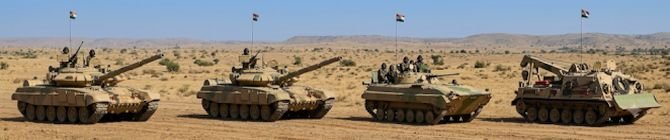
The Indian Army’s armoured corps has long relied on the T-90 Bhishma, but drone warfare is demanding a fundamental rethinking of how the tank fights and survives, according to TOI.
As demonstrated in Ukraine, the spread of low-cost FPV drones and precision-guided weaponry has changed the nature of warfare and forced India to develop new technology to safeguard its most crucial main battle tank.
With over 1,000 tanks in service, the T-90 Bhishma se
rves as the foundation of India’s armored army. Through technology transfer, the fleet, which was first purchased from Russia in 2001, has been manufactured more and more domestically.The Army
An important milestone in India’s defense industrial base was reached in May 2026 when the Army received the 1,000th locally produced T-90 Bhishma from the Heavy Vehicles Factory in Avadi.
The 46.5-ton tank is powered by an Indian-built 1,000-horsepower V-92S2 diesel engine and is intended for high-intensity conventional warfare. This makes it possible to travel across deserts, plains, and semi-mountainous terrain at speeds of up to 60 km/h. Its main weapon is a 125 mm 2A46M smoothbore gun that can fire fragmentation, high-explosive anti-tank, and armor-piercing roundAdditionally, it has a 12.7 mm anti-aircraft machine gun and a 7.62 mm coaxial machine gun. The tank can function with a three-person crew consisting of the commander, gunner, and driver thanks to an autoloader.
Military planners now see survivability as the bigger obstacle, even though the T-90’s firepower is still strong. In addition to nuclear, biological, and chemical defense systems, the tank is shielded by composite armor and Kontakt-5 Explosive Reactive Armor. However, previous conflicts—especially the conflict between Russia and Ukraine—have shown that armor by itself provides no defense against loitering missiles and FPV drones that target sensitive locations like the engine deck, turret roof, and external sensors.
sThe Indian Army’s T-90 fleet does not yet have a hard-kill Active Protection System that can stop incoming anti-tank guided missiles, rocket-propelled grenades, or attack drones before they reach the vehicle, in contrast to a number of more recent Western and Israeli tanksThe Army released a Request for Information in February 2025 for a modular indigenous APS for its T-90 fleet, acknowledging the changing threat. It is anticipated that the proposed system will integrate hard-kill interceptors that eliminate incoming threats prior to contact with soft-kill techniques such as smoke grenade launchers, electronic jammers, and laser warning receivers.Weapons & Firearms
Additionally, the Army has stipulated that the system must be made in India, integrate smoothly with the current tank, and have counter-unmanned aircraft system capabilities to resist FPV drones, loitering munitions, and top-attack weaponry.
The Defence Research and Development Organization is creating an indigenous hard-kill APS in addition to the Army’s purchase initiatives. The system, which was first demonstrated at Aero India 2025, has turret-mounted interceptors intended to neutralize incoming anti-tank threats and four X-band radar screens that provide 360-degree coverage.
There are also more extensive improvements being made to the T-90 itself. The Heavy Vehicles Factory’s most recent T-90 Bhishma Mk
III features a number of domestic upgrades, such as an automatic target tracker, a digital ballistic computer derived from the Arjun main battle tank to increase first-round hit probability, and a mid-wave thermal imaging commander sight with an 8 km detection range created by DRDO and Bharat Electronics Limited.
.In order to increase mobility, especially in high-altitude areas where the existing 1,000-horsepower engine performs poorly, the Defence Acquisition Council has also approved the purchase of more potent 1,350-horsepower enginesThe T-90 Bhishma continues to be one of the Indian Army’s most capable and battle-tested tanks despite the evolving nature of warfare.However, as drones proliferate on contemporary battlefields, their future efficacy will depend not just on the strength of their weaponry or the thickness of their armor, but also on their capacity to identify, neutralize, and eliminate threats before they get to the vehicle.Russia-India Relations
Therefore, the Bhishma’s survival and significance in the coming decades will depend heavily on the integration of APS and counter-drone technologies.
.
.