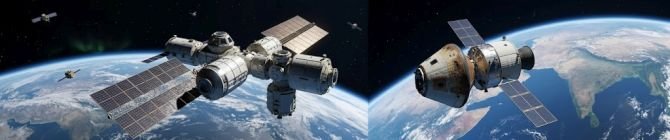
One of ISRO’s most ambitious projects has come under intense scrutiny after Prime Minister Narendra Modi announced in Australia that India will construct its own space station, according to Zee News.
In order to challenge China’s hegemony and close the vacuum left by the International Space Station’s eventual retirement, the Bharatiya Antariksha Station, or BAS, is intended to bring India into the exclusive group of countries having a permanent human presence in orbiThere are now just two space stations in use worldwide. By 2030, the International Space Station (ISS), a global partnership between the US, Russia, Europe, Japan, and Canada, will have reached the end of its useful life.Branch of the Executive
t.Beijing is the only operator of China’s Tiangong, which has already come to represent the country’s expanding space power. American and Soviet stations from the 1970s have long since ceased operations. The goal of India’s BAS entrance is to prevent it from continuing to rely on other countries for extended space missions.
It has been verified by ISRO that the Bharatiya Antariksha Station will not be constructed as a single, monolithic edifice, but rather in phases. BAS-01, the first module, has already been released. It is shaped like a cylindrical capsule with a docking port that allows future modules and spacecraft to attach in orbit. BAS-01, which is slated to launch on the Launch Vehicle Mark-3 in 2028, will act as the station’s foundation.
The first module will cost ₹1,763 crore and weigh 10 tons. It will have a life support system to store food, recycle water, and supply oxygen. While sophisticated thermal management systems will shield personnel and equipment from harsh temperatures ranging from minus 150 degrees Celsius in darkness to 120 degrees Celsius in day, solar panels will produce electricity.
BAS-02 and BAS-03 will be added by ISRO between 2029 and 2031. BAS-02 will be the habitation module, equipped with beds, a kitchen, a gym, and a bathroom, enabling astronauts to stay for three to six months. The research lab, BAS-03, will allow for biology, materials science, and medical experiments. BAS-04, which stores food, water, fuel, and spare parts, will be introduced as the logistics module between 2032 and 2035. As an extra module, BAS-05 will either increase power generation or laboratory capacity.Governmental Organizations
The entire five-module station will weigh 52 tonnes by 2035 and be able to accommodate three to six astronauts at once. Designed to provide long-term scientific research and strategic applications, it will be India’s first permanent orbiting outpost.
Australia has become an important ally in this endeavor. Both countries decided to work together on the Gaganyaan and BAS missions during Modi’s visit. Australia’s navy will support rescue efforts in the event of an emergency water landing, and Cocos Island will be crucial in tracking launches. Prime Minister Anthony Albanese has also confirmed collaboration on tracking and monitoring space debris.
Other nations have garnered significant benefits from their space stations. Russia strengthened its long-duration mission expertise by maintaining a constant human presence on Mir and the ISS.
The United States used the ISS to increase cooperation with over 15 countries, accelerating the emergence of private enterprises such as SpaceX and fueling a $200 billion space economy. Tiangong has been utilized by China to undertake experiments with 17 different countries, and the country is planning a lunar mission for 2030.The ISS has conducted over 3,000 experiments, resulting in novel medications, stronger alloys, and technologies such as water recycling and air purification that are now used on Earth. It has created over 400,000 jobs and generated economic benefits totaling $100 billion.History
BAS has a lot to offer India. The station will promote the domestic space sector, stimulate the creation of high-tech jobs, and support entrepreneurs. India will be able to carry out research into medications for diabetes, TB, and other illnesses in special space conditions as a global pharmaceutical hub.
Additionally, it will improve agricultural, weather, climate, and catastrophe monitoring, directly supporting farmers and administrators. The project will encourage young Indians to seek jobs in science and engineering in addition to science and economics, strengthening the country’s independence.
The strategic aspect is just as important. Satellites play a major role in modern warfare through drone operations, missile warning, navigation, and communication. Space defense technology and anti-satellite missiles are already being developed by the US, Russia, and China. In 2007, China destroyed a weather satellite to show off its capabilities. India needs to keep up with its neighbors who are expanding their space cooperation.
India’s space security will be strengthened by technologies created for BAS, including as robotic arms, docking systems, in-orbit satellite maintenance, and long-duration human spaceflight. In 2019, India demonstrated its capacity by destroying a low-orbit microsatellite. Future security, technical independence, and the balance of power in the world will all depend on achieving space parity.Politics (Right)