For the fiscal year that ends on March 31, 2026, Hindustan Aeronautics Limited has dramatically lowered its forecasts for both domestic fighter and training aircraft.
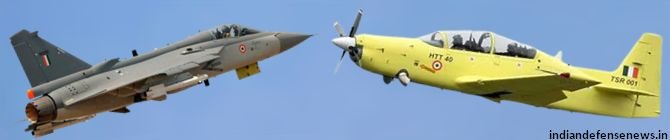
The state-run aerospace major now aims to deliver five TEJAS MK-1A fighters and three Hindustan Turbo Trainer-40 basic trainers to the Indian Air Force by the end of the current financial year, compared to the earlier targets of ten fighter jets and twelve trainers respectively. The
A number of issues that have affected HAL’s production timetables are reflected in the revised delivery schedule. The speed at which American manufacturers are supplying engines continues to be the key obstacle affecting both aircraft programs.
Delays in General Electric Aerospace’s delivery of F404-IN20 turbofan engines have caused assembly process bottlenecks for the TEJAS MK-1A, while supply problems in Honeywell’s TPE331-12B turboprop engines have similarly limited manufacturing rates for the HTT-40.
The schedule has also been further extended by the completion of crucial armament trials for the TEJAS MK-1A, which are a necessary precondition before aircraft can be delivered to the IAF. The
Officials at HAL, however, have voiced hope in overcoming these setbacks. In order to improve the air force’s combat capability, the state-owned company thinks it can meet its overall supply targets and gradually make up for the existing gap in the upcoming years.
The Indian Air Force, which has major concerns about the delayed induction of new fighters and the possible hazards such delays pose to operational readiness and national defense capabilities, continues to keep a careful eye on the issue. The
The updated delivery goals must be interpreted in light of the IAF’s significant orders. For a total of 180 TEJAS MK-1A aircraft, valued at ₹1.1 lakh crore (roughly 13.75 billion US dollars), the air force has obtained two separate contracts. The first order, for 83 fighters, was signed in February 2021, and the second contract, for 97 additional aircraft, was approved in September 2025.
The first contract calls for the delivery of five MK-1A fighters by March 31, 2026, over the course of four to five years of execution. The second order’s deliveries are expected to start in 2027–2028 and last for six years. The
It should be mentioned that, in comparison to earlier projections, the program has experienced significant delays. The current amended timescale is significantly behind the initial estimated schedule, as the first aircraft under the 2021 contract was originally supposed to be delivered in March 2024. The
The
The MK-1A program is now severely hampered by the engine supply. As the American company has overcome supply chain disruptions that had previously limited manufacturing, General Electric Aerospace has supplied five F404-IN20 engines to date, with a further twenty units anticipated for the 2025–2026 fiscal year.
From 2027 onward, the engine manufacturer has pledged to deliver more than twenty engines each year, which should enable an acceleration of aircraft deliveries once this vital component is reliably accessible. The
There is reason for cautious optimism as weapon trials have advanced significantly. Through weapon trials, the TEJAS MK-1A program has shown consistent development, and another round of crucial testing is slated for late December 2025.
HAL anticipates being in a position to recover from the current delays as these experiments get closer to completion and engine supply stabilize in the upcoming year. Deliveries of the HTT-40 trainer and the TEJAS MK-1A are expected to be accelerated by the construction of additional manufacturing facilities. The
In order to accommodate higher delivery rates, HAL has greatly boosted its production capacity. At its Bangalore plant, the company can produce sixteen TEJAS MK-1A aircraft a year. In October 2025, Defense Minister Rajnath Singh opened a new production line in Nashik, increasing the company’s overall production capacity to twenty-four aircraft annually. The combined manufacturing capacity of HAL’s Bangalore and Nashik plants enables the production of about twenty HTT-40 trainers per year. TheThe
While operating under different constraints, the HTT-40 program encounters similar challenges with engine supply. About two years ago, the Indian Air Force ordered seventy basic trainers worth ₹6,838 crore to train rookie pilots. However, the program has slowed significantly because of the delayed delivery of TPE331-12B turboprop engines from the American company Honeywell, which has experienced global supply chain bottlenecks.
A $100 million contract signed three years prior for the supply and manufacture of eighty-eight engines and kits, of which thirty-two were supplied directly by Honeywell and the remaining units were manufactured by HAL through technology transfer agreements, required Honeywell to deliver the first engine in September 2025. The
The HTT-40 program’s current engine supply timetable spans a long period of time. It is now projected that the first engine will be delivered in January 2026, followed by four more units by March 31, 2026, with further deliveries taking place at a rate of two engines per month.
Aircraft assembly has advanced independently of the new engine supply bottleneck, as evidenced by the fact that two series-production HTT-40 aircraft are now flying using “Category B” (previously used) TPE331-12B engines that initially powered prototype aircraft.
Under the seventy-aircraft contract, HAL was initially supposed to provide twelve basic trainers to the IAF during the 2025–2026 fiscal year. The first delivery was supposed to take place in September 2025, but this goal has since been superseded by the updated delivery plan. The
An important infrastructure investment intended to support India’s aerospace aspirations is represented by the recently opened production facilities in Nashik. Defense Minister Rajnath Singh opened production lines specifically for the TEJAS MK-1A and HTT-40 at HAL’s Nashik division in October 2025.
The MK-1A production line in Nashik, which was operationalized in just two years after it was established, has the capacity to produce eight aircraft annually. This capacity can be expanded to ten aircraft annually, increasing HAL’s total manufacturing capacity from the current sixteen aircraft annually at Bengaluru to a combined twenty-four aircraft annually when both facilities are operating at full capacity.
In keeping with the government’s larger push for public-private partnerships in defense manufacturing, the project has also created about 1,000 new job opportunities and partnerships with over forty private industry suppliers throughout Maharashtra, Gujarat, and Madhya Pradesh, accounting for about 40% of the total workload. The
In the IAF’s training system and pilot development pipeline, the HTT-40 is especially important. Currently, Pilatus PC-7 MK-II basic trainers of Swiss origin are used for all rookie pilots’ initial stage (Stage-I) flying training. Pilots are trifurcated into fighter, transport, and helicopter streams based on aptitude and assessment after successfully completing Stage I training. Before being certified to fly supersonic fighter aircraft, pilots chosen for the fighter stream go through Stage-II training on the PC-7 MK-II and Kiran MK-1A jet trainers and Stage-III advanced training on British-origin Hawk advanced jet trainers. Pilots from the transport and helicopter streams receive their Stage-II and Stage-III training on various types of helicopters and transport aircraft, respectively. The
The issues that are presently impeding the delivery of the TEJAS MK-1A and HTT-40 aircraft go beyond straightforward supply chain interruptions and are indicative of more extensive structural limitations in India’s defense manufacturing sector.
Given the diminishing squadron size and the gradual retirement of aging aircraft like the MiG-21 fleet, the IAF acknowledges the need to expedite the induction of the TEJAS MK-1A fighters.
Similar to this, the lack of basic trainers limits the IAF’s ability to teach the next generation of competent pilots, posing a strategic problem that goes beyond short-term aircraft acquisition to include long-term force development and operational readiness. The
HAL’s updated delivery goals reflect a practical recognition of present production limitations while preserving optimism for a future recovery. Although the current fiscal year will see significantly fewer deliveries than originally anticipated, the aerospace manufacturer’s trajectory suggests improving performance in subsequent years with critical components now becoming available at stabilized rates and new manufacturing infrastructure now operational. The