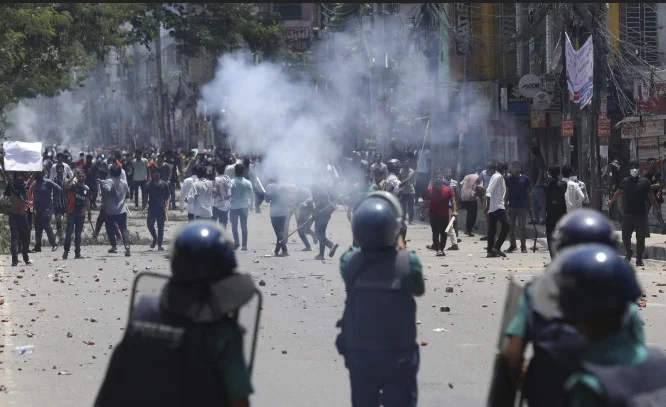
Following the passing of Inquilab Mancha spokesperson Sharif Osman Bin Hadi, a well-known activist and prospective election candidate, protests broke out around Dhaka. Major media outlets have been the subject of violent altercations; Prothom Alo and The Daily Star’s offices in the capital’s Karwanbazar neighborhood have been heavily attacked.
On Thursday, December 18, 2025, at around midnight, the attack on Prothom Alo’s office began. According to Nagorik, crowds came after learning of Hadi’s passing, starting flames visible on nearby roads and vandalizing the property with sticks.
The Daily Star building was then targeted, and live social media recordings and eyewitness reports showed flames consuming the building. Concerns about safety are raised by the fact that some workers are still stuck inside the offices amid the mayhem.
On December 12, Sharif Osman Hadi was shot and killed in the Purana Paltan neighborhood of Dhaka. While campaigning in a battery-powered rickshaw, he was shot in the head by a motorcycle attacker.
Hadi underwent emergency brain surgery as part of his first care at Dhaka Medical College Hospital, but his condition quickly worsened. According to doctors quoted by the Dhaka Tribune, the bullet had entered above his left ear and left through the right side, severely damaging the brain stem.
On December 15, he was evacuated to Singapore General Hospital for advanced care after being moved to Evercare Hospital. Hadi died in spite of their efforts, leaving Bangladesh in sadness.
The tragedy’s significance was heightened by Hadi’s involvement in the July Uprising and his potential candidacy for Dhaka-8 in the 2025 national elections. Fears about election stability in the interim government era have been heightened by his assassination.
In response, Muhammad Yunus, Chief Advisor for Bangladesh, quickly proclaimed Saturday, December 20, 2025, a national day of mourning. Government, semi-government, private, educational, and Bangladeshi embassies overseas will all have flags flying at half-mast.
Yunus pledged welfare help to Hadi’s wife and sole kid, highlighting the government’s support for his family. Following Jummah, on Friday, December 19, special prayers are planned to ask God to pardon the “Martyr’s” soul.
The demonstrations highlight the growing political unrest in Bangladesh. Hadi’s killing, which has been connected to targeted violence during campaigning, raises concerns about opposition leaders’ safety in the run-up to elections.
Symbols of independent journalism, media offices have been the target of popular outrage, which may be a reflection of dissatisfaction with how the revolt or Hadi’s advocacy was covered. According to Nagorik accounts, the mobs appeared on their own after learning of his death.
Social media footage shows smoke rising from Karwanbazar as demonstrators launch projectiles and start fires. The continuous disturbance makes it difficult for emergency services to reach the locations.
Since the July Uprising, which overthrew the previous government and imposed Yunus’s interim government, there has been a pattern of violence, which is seen in this episode. The Inquilab Mancha group led by Hadi has been outspoken in advocating for changes.
No arrests have been verified as of yet, but investigators are still looking into the motorcycle-borne shooting. The attack’s accuracy raises the possibility of political motivations.
In his speech to the country, Yunus referred to Hadi as a “Martyr,” portraying the death as a national tragedy. His welfare pledges are an attempt to appease bereaved supporters and stop things from getting worse.
Security personnel have been stationed in Karwanbazar to put an end to the violence while Dhaka simmers. Attacks by the media run the potential of further polarizing public opinion, particularly in light of the approaching elections.
The delicate shift in Bangladesh has wider ramifications. The demonstrations might give hardliners more confidence, making Yunus’s reform plan more difficult to implement and undermining the trust of foreign observers in the process.
A recurrent theme in high-profile situations is Bangladesh’s dependence on foreign medical knowledge for crucial cases, which is highlighted by Hadi’s treatment in Singapore. His death abroad has heightened indignation at home.
Friday’s prayers could be a focal point for larger gatherings given the ongoing national grief. Authorities advise moderation, but the pain over Hadi’s death doesn’t seem to be lessening.
Important information channels are disrupted by the burning of Prothom Alo and The Daily Star offices, which may hinder reporting on the developing crisis. Calls for protection are increased when journalists are trapped.
In the context of regional geopolitics, neighbors like India are concerned about the potential repercussions of Bangladesh’s instability. Cross-border interest in the developments is highlighted by ANI’s coverage.
In the end, Sharif Osman Hadi’s murder represents a somber turning point, turning individual misery into collective resentment and jeopardizing Bangladesh’s hopes for democracy.
