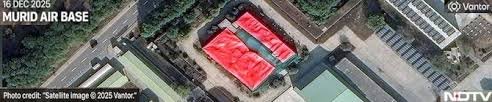
A crucial command and control structure at Pakistan’s Murid Airbase is undergoing major restoration, according to new high-resolution satellite images from Vantor dated December 16. This facility is completely covered in a massive crimson tarpaulin after being hit by the Indian Air Force on May 10th during Operation Sindoor.
Adjacent to a sizable structure that houses Pakistan’s unmanned aerial vehicle (UAV) operations, the covering hides what looks to be significant repair work.
According to assessments, the precision hit caused significant structural damage, partial roof collapse, and likely serious internal devastation. Only a modest green tarpaulin was visible over damaged areas in the first post-strike photos from June, indicating that initial evaluations were still in progress.
The current complete enclosure, which includes construction netting and heavy-duty red tarpaulin, shows that rebuilding works have intensified in order to conceal crucial repairs and rubbish removal from aerial reconnaissance.
Such tarpaulins are normal military practice for hiding reconstruction at damaged sites, according to satellite imagery analysts like Damien Symon. Symon notes that while the current size suggests more internal damage than first appeared, the initial partial covering in June probably coincided with structural assessments. The strategic significance of the strike is shown by this building, which is essential to PAF operations.
Located in the Chakwal District of Punjab, PAF Base Murid serves mainly as a center for unmanned combat aerial vehicles (UCAVs) and UAVs. Platforms including the Shahpar series, Burraq, Bayraktar-TB2 and Akinci, and Wing Loong-II are supported. In response to Pakistan’s increasing drone incursions, which were identified at more than 26 locations the day before, the Indian Air Force bombed it.
The attacks took place early on May 10, right before Major General Kashif Abdullah, Pakistan’s Director General of Military Operations, suggested a cease-fire to Lieutenant General Rajiv Ghai, his Indian counterpart.
With the IAF reacting to Pakistani attacks on its Integrated Air Command and Control System (IACCS) nodes, airbases, and S-400 units, this was the height of the 88-hour conflict’s military escalation. Facilities at Udhampur, Pathankot, Adampur, and Bhuj suffered some damage as a result of those attacks.
Images from the main attack on Murid show clear roof cave-ins, suggesting that the weapons were capable of piercing roofs. Evidence points to precision-guided missiles with delayed-fuse penetrators, however the IAF has not revealed specifics. These missiles maximize disruption to workers and equipment by using hardened casings and kinetic energy to penetrate metal or concrete roofs before detonating interior.
Just thirty meters from an underground PAF facility, a secondary impact that day created a crater that was three meters large. According to expert research, earth-protected entrances are a sign of either an operating shelter built to survive heavy bombardment or fortified storage for specialized equipment. These characteristics emphasize Murid’s contribution to safeguarded UAV-related assets.
The effectiveness of the strike and Pakistan’s subsequent response are confirmed by sequence imagery, which shows intact structures prior to the hit, immediate post-strike devastation, and current reconstruction. The deployment of the tarpaulin is consistent with more general patterns of rehabilitation throughout PAF bases that were damaged during Operation Sindoor.
At some locations, Pakistan has started extensive restoration. The runways at Rahim Yar Khan in southern Punjab and Mushaf Airbase in Sargodha, which were cratered to prevent fighter operations, have been completely rebuilt. By allowing combat aircraft operations to resume, these repairs lessen the prior impediments.
IAF raids destroyed hangars in Jacobabad, Bholari, and Sukkur. According to intelligence, a crucial Airborne Early Warning and Control (AEW&C) aircraft was lost in Bholari’s hangar strike, and many PAF F-16s were destroyed on the tarmac at Jacobabad. A hangar that housed UAVs has been destroyed and leveled in Sukkur.
Additional developments include the replacement of a complex destroyed by IAF operations with new buildings at Nur Khan Airbase in Chaklala, close to Islamabad. Although the tarpaulin at Murid indicates continued concealing of deeper vulnerabilities, these measures demonstrate Pakistan’s resolute determination to restore its aviation infrastructure after the battle.
The images highlight the accuracy of Operation Sindoor and the IAF’s capacity to weaken important PAF enablers, especially in the areas of drone warfare and UAV command. As restoration moves forward, it also demonstrates Pakistan’s decision to prioritize airbase recovery in the context of strategic adjustments. To assess long-term operational robustness, satellite monitoring must continue.