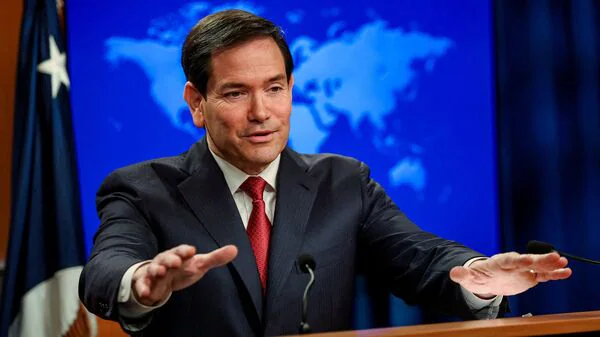
Pakistan’s offer to provide troops to the proposed International Stabilization Force (ISF) in Gaza, a crucial element of President Donald Trump’s 20-point peace plan, has been reaffirmed by US Secretary of State Marco Rubio.
Speaking on Friday in Washington, DC, Rubio thanked Pakistan for its openness, pointing out that it has at least promised to think about taking part. He emphasized that before any country can be asked to make firm pledges, more details are required.
In answer to questions regarding formal consent from Pakistan, Rubio made these statements. “We’re very grateful to Pakistan for their offer to be a part of it, or at least their offer to consider being a part of it,” he said.
“I think we owe them a few more answers before we can ask anybody to firmly commit.” This suggests that diplomatic talks are still going on despite the mission’s uncertainties.
The US Secretary of State expressed hope for more international assistance. He expressed optimism about obtaining contributions from “a number of nation-states acceptable to all sides in this conflict who are willing to step forward.” These guarantees imply that the Trump administration is actively pursuing a number of allies in order to guarantee the survival of the ISF.
However, Pakistan’s stance is still cautious. The Pakistani Foreign Office has stated that no final decision has been made about troop contributions, according to a Dawn report.
During a weekly news briefing on Thursday, Foreign Office spokesperson Tahir Hussain Andrabi discussed the issue, saying, “Regarding Pakistan’s participation in the ISF, no decision has been taken to join the force as of now.”
The rising rumors of pressure from the incoming Trump administration are refuted by this statement from Islamabad. According to reports, Washington may be using long-standing bilateral ties to pressure Pakistan to contribute troops. However, given a dangerous regional environment, Pakistan’s ambivalence reflects both strategic calculations and internal sensitivities.
A key component of Trump’s 20-point plan, which mediated an October cease-fire between Israel and Hamas, is the ISF. Comprehensive peacebuilding initiatives, such as demilitarization, security improvements, and reconstruction in Gaza, are outlined in the plan. A temporary instrument to monitor these goals is the deployment of a multinational stabilization force.
A resolution supporting the concept and approving the creation of the ISF was approved by the UN Security Council on November 17. Important Western nations supported the vote, but China and Russia abstained. Notably, despite concerns about operational engagement, Pakistan voted in favor, indicating support for the initiative at the global level.
Pakistan’s present ambivalence on soldiers, possibly due to geopolitical rivalries, contrasts with its favorable UN attitude. Islamabad, a country with a majority of Muslims and a long history of supporting Palestinian causes, must weigh public opinion at home against US strategic advances. Any direct involvement in Gaza is complicated by the ongoing tense relations with Israel.
The push is consistent with the Trump administration’s larger reset of Middle East policy. Reviving the ISF highlights attempts to stabilize Gaza following the ceasefire and avoid a return to violence. According to Rubio’s remarks, Pakistan’s participation might increase the force’s legitimacy among Muslim and Arab nations.
Contributions to UN missions in Somalia and Bosnia, among other trends in previous interactions, are used to speculate about US pressure on Pakistan. Pakistan has previously sent more than 200,000 troops to 41 UN peacekeeping missions, making it the country with the greatest total troop commitment in the world. It is a strong contender for the ISF because of its past performance.
However, Pakistan faces many dangers. Troops may be exposed to asymmetric attacks from extremist remnants if they deploy to Gaza, taxing military resources already allocated to border conflicts with Afghanistan and India. Given its financial difficulties, Islamabad might be persuaded by financial incentives like military assistance or IMF bailouts.
In light of South Asian dynamics, India’s viewpoint is worth considering. New Delhi has strengthened defense ties with Israel, including billion-dollar arms purchases. Any Pakistani military deployment in Gaza might subtly support stories about Pakistan’s adventurism, drawing criticism from India in international fora such as the UN.
The ISF’s makeup will be crucial on a regional level. Rubio’s mention of “acceptable” countries suggests that Sunni-majority contributors like Pakistan, Jordan, or Egypt are preferred over Iran-aligned entities. Saudi Arabia’s possible involvement is yet unknown until relations with Israel are normalized.
Reservations are shown by China’s and Russia’s UN abstentions. Beijing may want neutrality due to its economic interests in the Middle East through the Belt and Road initiatives. Moscow, which supports Hamas, probably believes that the ISF advances US interests.
The ISF’s timeframe is still subject to change as of December 20, 2025. A mission is provided by UN authorization, but finance, rules of engagement, and force size continue to be practical obstacles. If accepted, Pakistan’s offer might hasten deployment, aiming for operations in early 2026.
This development highlights Trump 2.0’s shifting allies. Pakistan’s overture is a practical balancing act between regional solidarity and US support. Resolved ambiguities will determine final pledges, and Rubio’s diplomacy will be crucial in mobilizing support.
As a result, the stabilization effort in Gaza moves into a sensitive stage where Pakistan’s involvement in Trump’s grandiose peace architecture may prove crucial or contentious.