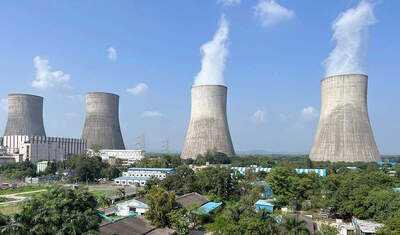
After passing both Houses of Parliament on December 18 and 19, 2025, the Sustainable Harnessing and Advancement of Nuclear Energy for Transforming India (SHANTI) Bill, 2025, has become a historic piece of legislation.
The Atomic Energy Act of 1962 and the Civil Liability for Nuclear Damage Act of 2010 are repealed by the Bill, which was introduced during India’s push for energy independence. With a goal of 100 gigawatts of capacity by 2047, it is a daring move to increase nuclear power’s share of the country’s energy mix.
In a statement on X, Randhir Jaiswal, a spokesperson for the Ministry of External Affairs, emphasized the Bill’s revolutionary potential and called it a critical step in India’s energy and technology environment.
In order to position it to power energy sovereignty, green manufacturing, and artificial intelligence, he emphasized its base in nuclear safety, sustainability, and innovation. Jaiswal noted improved international cooperation through adherence to global best practices and emphasized prospects for youth, start-ups, and industry.
In his own X post, Prime Minister Narendra Modi expressed similar views, praising the Bill’s passing as a “transformational moment” for India’s technological industry. He thanked lawmakers for their support and emphasized their part in ensuring a sustainable energy future for the world, not just India.
Modi urged stakeholders to “invest, innovate, and build in India” at this critical time, highlighting opportunities for youth involvement and private sector investment.
The Rajya Sabha quickly followed the Lok Sabha’s adoption of the Bill during its passage through Parliament. In his speech, Science and Technology Minister Jitendra Singh assured the audience that safety regulations are still strict and unwavering. He described how the Act will support national objectives, such as increasing the proportion of nuclear energy, encouraging advancements in atomic science, and expanding its uses beyond power production.
Singh went on to explain that the Bill fulfills India’s international commitments regarding nuclear liability, safety, security, and safeguards. India’s ambitious plan to attain energy independence, decarbonize the country by 2070, and incorporate indigenous nuclear contributions into the global ecosystem is in conflict with this. Advocates claim it will spur technological improvements and hasten the shift to clean energy.
Due to the Bill’s extensive ramifications, opposition voices voiced serious concerns during the discussions and demanded referral to a standing or select committee. Critics questioned if external forces influenced its hurried passage and claimed that liability clauses were diluted. Opposition members’ proposed amendments were eventually rejected, allowing for unaltered acceptance.
MEA-shared photos on X illustrate how the SHANTI Bill’s emphasis on international cooperation creates opportunities for reactor development partnerships. This could draw in foreign technology and investment and is consistent with India’s obligations under international nuclear frameworks. By lowering reliance on fossil fuels in the face of geopolitical unpredictability, such actions could strengthen India’s strategic autonomy in energy security.
The law offers incentives and liberalization to the private sector, creating a competitive environment for nuclear endeavors. Simplified frameworks can help startups in AI, sophisticated manufacturing, and nuclear technology, encouraging innovation in fields like compact modular reactors and non-power uses like healthcare isotopes.
The Bill’s creation of job pipelines in high-tech nuclear industries highlights youth participation as a crucial pillar. In line with India’s demographic dividend, educational partnerships and skill-building initiatives could fill gaps in specialized labor. This presents the law as a driver of sustained economic expansion and technological independence.
Importantly, the repeal of earlier Acts removes long-standing obstacles, including as liability concerns that discouraged private involvement after Fukushima. The simplified system seeks to strike a balance between risk and advancement while maintaining safety, learning from international counterparts such as the United States and France.
India’s nuclear aspirations under SHANTI complement more general “Make in India” campaigns, encouraging the indigenization of reactor designs and fuel cycles. The 100 GW goal could power mega-infrastructures by 2047, including electrified industries that support net-zero commitments and data centers that power AI.
There are still issues with financing, public perception, and waste management. However, the government’s guarantees about safety procedures allay concerns, and the Bill’s passing represents a consensus-driven breakthrough. Monitoring systems will be essential as deployment progresses to fulfill its potential.
In the geopolitical sphere, SHANTI enhances India’s reputation as a responsible nuclear operator and may strengthen ties in civil nuclear areas with allies like the US and Russia. Improved energy security and strategic leverage in Indo-Pacific dynamics could result from this.
The SHANTI Bill, which combines energy, technology, and sovereignty, ultimately captures India’s vision for a nuclear renaissance. Execution is key to its success, but early leader endorsements point to significant momentum in the direction of a sustainable future.