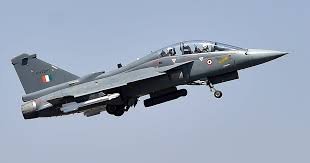
The TEJAS MK-1A program has come under renewed criticism due to a picture that has been making the rounds on social media and has also been shown on IDN. The photograph, which was shared by Alpha Defence and other defense outlets, shows a TEJAS MK-1A with tail number LA5051. The TEJAS MK-1A airframe is the 19th to reach the coupling stage, with tail numbers starting at LA5033.
Approximately 19 airplanes are currently fully manufactured, according to this milestone. This is equivalent to at least one whole squadron on paper. However, these planes are still grounded, raising the urgent question of why Hindustan Aeronautics Limited (HAL) has not delivered the airframes to the Indian Air Force (IAF) if they are manufactured.
The fundamental difference between “manufactured” and “accepted” is what’s destroying this agreement. From HAL’s perspective, coupling signifies the end of manufacturing. However, until an aircraft meets all contractual requirements, it is considered incomplete by the IAF.
A thorough evaluation has been announced by the IAF for May. It won’t start accepting anything until it is completely satisfied. As a result, even optimistically, the first batch, which was supposed to arrive in March 2024, now threatens slippage past June or July.
Frustrations have been exacerbated by HAL’s frequent failure to meet program deadlines. According to HAL, five TEJAS MK-1A jets are prepared for delivery, and the imaging indicates that 10 additional airframes are finished. It primarily blames General Electric’s (GE) delayed engine deliveries for the delays.
The IAF disputes this story. According to sources, the jets are not in compliance with the Air Staff Qualitative Requirements (ASQR) because of unresolved differences. Deliveries are contingent upon HAL providing the promised configuration, which includes smooth interfaces.
According to reports, HAL pledged post-delivery improvements for radar and armaments in order to propose temporary acceptance in the existing state. There are precedents: the 36 French-built Rafale planes went into service without some features, like the X-Guard towed decoy.
Due to its critical significance, the IAF rejects this for TEJAS MK-1A. India’s future interceptor fleet must be anchored by the Mk1A, as squadron numbers are now below thirty. Partial readiness is an unacceptable strategic risk after years of expectation.
The incorporation of the Astra MK-1, the foundational beyond-visual-range (BVR) missile, is a topic of debate. Trials are over, according to HAL, and Astra is in sync with the Israeli EL/M-2052 radar. However, the IAF requires comprehensive integration for all systems and avionics.
Radar harmonization with mission computers, displays, and weapons is a requirement of true integration, which goes beyond simple launches. Prior to advancement, the IAF requires system-level accreditation.
Induction requires two unchangeable stages. First, all technical integrations must be corrected and certified. Second, IAF pilots assess operational efficacy over a period of days or weeks in rigorous acceptance trials.
Due to its squadron crises, the IAF does not tolerate delays. Given HAL’s extended grace period, its only requirement is complete operational maturity. The phrase used by HAL—”major contracted capabilities” on five jets—betrays inadequacy rather than completeness.
HAL acknowledges the need for continuous design improvements, highlighting immaturity issues. Without engines, scale-up fails after the first batch. GE’s 2021 order for the F404-IN20 encountered difficulties because its production line had shut down and had to be restarted due to COVID-19 supply issues.
Just five engines have been supplied by GE so far, and none in 2026. A second line activates at GE’s US factory, which was recently visited by the head of HAL. An upcoming trade agreement between the US and India could speed up resolutions.
By the end of the year, 24 engines are anticipated. Using current construction, ten airframes might fly if four or five arrive before the middle of the year. Armed with Astra MK-1 and MK-2, this might result in 24 operational TEJAS MK-1A by December.
Due to the fleet’s vulnerability, these aircraft are essential, serving as a link between the TEJAS MK-2 and future Rafales. The MK-1A is a 4.5-generation multi-role stalwart thanks to its 50 kiloNewton thrust F404 engine and local avionics such the Uttam AESA radar (which is still awaiting final implementation).
Delays have strategic repercussions. China’s J-20 stealth fighters are widely available, and Pakistan is considering purchasing J-31 aircraft. India’s 18 fighter squadrons, compared to a sanctioned 42, highlight how urgently MK-1A infusion is needed.
After 2026, HAL plans to increase its Nashik and Bangalore lines to 16–24 planes per year. ASQR adherence is still non-negotiable, though. As a litmus test, the May review is approaching.
Speed is determined by engine inflows. Starting in Q3 2026, GE plans to produce 12 engines every three months, with the possibility of increasing to two squadrons annually. Nal Airbase’s simulators and other IAF training pipelines are ready.
Over 65% of the content is indigenous, supporting Atmanirbhar Bharat. As Astra MK-2 trials progress, BVR is increased to 160 kilometers. Precision bombs, R-73 variants, and Astra are examples of full-spectrum integration that increases the power of MK-1A.
HAL’s execution is criticized by critics, who contrast it with the agility of private sector bids like TATA-TEJAS. However, faith is confirmed by 97-export endeavors and 83-jet orders (73 more after 40). Resolution depends on HAL maturation and GE dependability.
The capability of the IAF is protected by its firmness. After decades of indigenous labor, TEJAS MK-1A is almost ready for release—but only if compromises give way to rigor.