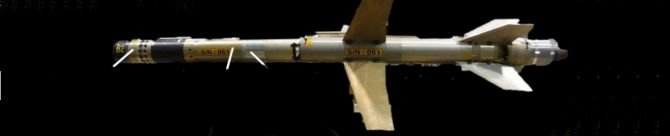
The Iranian-developed 358 missile, commonly referred to as Saqr-1 or SA-67, has been the subject of conjecture following reports that a US Air Force F-35 stealth jet was shot down with it. The SA-67 is a High-Explosive-Fragmentation (HE-Frag) rocket-booster-launched Surface-To-Air-Missile (SAM), sometimes referred to as the coded designation 358 and Saqr-1 (Hawk) guided missile.
The missile is especially well-suited to ambushing cutting-edge aircraft because of its special loitering capability, which combines a rocket booster for launch and a turbojet engine for continuous patrol in a figure-eight pattern.
The system is made to avoid detection and strike precisely thanks to its minimal electromagnetic signature, optical laser proximity fuse, and imaging infrared seeker.
The allegation highlights the rising fear that relatively inexpensive, hybrid air defense missiles could pose a severe threat even to fifth-generation stealth planes, even though the claim of their usage against an F-35 remains unproven.
It is a loitering surface-to-air missile that was created by the IRGC Aerospace Force to combat drones, helicopters, and low-speed aircraft.
In contrast to traditional SAMs, it patrols a designated airspace and uses an imaging infrared seeker to scan for opportunities before striking its target. Because of this hybrid strategy, it is especially well-suited to contemporary asymmetric warfare, when unmanned aerial platforms are becoming more and more common.
The missile has three sets of fins that give it stability while in flight, and its structural dimensions are about nine feet long and thin. Its propulsion system consists of a tiny turbojet engine for cruise flight and a solid-fuel booster for launch.
Once in the air, the missile may sustain surveillance over a large region by loitering in a figure-eight pattern. It can stay in place until a target reaches its engagement envelope thanks to its endurance capability.
An Imaging Infrared seeker provides guidance, allowing the missile to precisely track and latch onto aerial targets. An optical laser proximity fuse detonates the warhead, which weighs around twenty-two pounds, thereby destroying the target without the need for a direct impact.
Because of this, the technology is especially deadly to drones and other comparatively delicate airborne platforms.
The missile is said to have a range of more than 100 kilometers, with some reports putting it as high as 150 kilometers. It can endanger medium-altitude, long-endurance drones that previously required sophisticated defense systems to neutralize because it can operate at altitudes of up to 28,000 feet.
Traditional radar systems find it challenging to detect and track due to its low electromagnetic signature.
Operationally, Iranian proxies like Hezbollah and the Houthis in Yemen have used the 358, highlighting its function as an instrument of regional force projection. Aerial platforms, especially those involved in surveillance and strike missions, have faced significant difficulties as a result of its presence in conflict areas.
Concerns about the missile’s proliferation and potential to destabilize regional air operations have been raised internationally after multiple shipments of the weapon were intercepted en route to Yemen.
Iran’s strategic goal to create affordable systems that can counteract opponents with superior technology is shown in the launch of the 358 missile. By using a comparatively inexpensive approach to target drones and other airborne assets, it changes the risk balance in disputed airspace and compels adversaries to modify their strategies and defenses.