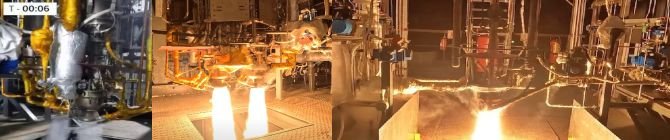
Agnikul Cosmos, based in Chennai, has successfully test-fired its ground-breaking 3D-printed, single-piece rocket engine, marking a significant milestone in India’s commercial space industry. The company’s Agnibaan rocket, which intends to provide flexible launches for tiny satellites, has made significant progress with this test.
The internal electric motor-driven, pump-fed, single-piece engines used in this dual-engine firing achieved thermal steady state and showed consistent system performance for 49 seconds. Because each of the four pumps utilized in this fire was powered by a separate electric motor, they were all unique. Most of the pump’s parts were made via 3D printing. In-house software was used to regulate the pump speed.
Instead of using the standard turbopumps seen in rocket designs, the engine uses a new electric motor to power its pumps. This electric pump technology improves mission flexibility by enabling fine throttle control and thrust adjustments with Agnikul’s unique indigenous software.
The engine’s “Agnilet” technology, in which several parts are 3D-printed as a single, continuous piece, is crucial to this accomplishment. This method represents a breakthrough in additive manufacturing for aircraft propulsion by significantly streamlining production procedures, reducing assembly time, and minimizing potential failure sites.
In order to validate the electric pump architecture under actual firing conditions, the test used a dual-engine arrangement. Both engines showed off their sophisticated throttle control, dependable firing, and the system’s ability to cluster several units to power larger launches.
Liquid oxygen (LOX) and refined kerosene, a non-cryogenic mixture that has practical benefits in handling and storage over fully cryogenic fuels, were the propellants utilized in the test. Agnikul’s emphasis on operational efficiency for frequent, on-demand releases is consistent with this decision.
For complex missions, like as those using reusable launch vehicles, it is essential to successfully demonstrate finer control and reliability. The electric motors were controlled by Agnikul’s proprietary software, which was crucial in ensuring steady performance at different thrust levels.
The Agnibaan rocket, which is intended for tiny satellite payloads weighing between 30 and 300 kg, will incorporate clusters of these engines thanks to this test. This capacity puts India in a competitive position in the
growing demand for specialized smallsat launches worldwide.
Agnikul’s advancement highlights the development of India’s private space sector, which has been fueled by programs like IN-SPACe and the relaxation of launch regulations. Since its founding in 2017, the company has quickly expanded from idea to hot-fire testing, surpassing many of its international competitors in the widespread use of 3D printing.
Agnikul lowers engine complexity and development costs by substituting more straightforward electric systems for complex turbopumps. High-power motor-driven electric pumps provide low-level throttleability, which is crucial for accurate orbital insertions and future landing maneuvers in reusable rockets.
The single-piece 3D-printed design is resistant to the high heat and pressures of combustion since it was created using sophisticated metal additive manufacturing. This invention helps agile startups in the space race by speeding up prototyping and enabling quick iterations.
In the future, multi-engine firings and full-stack qualification for Agnibaan’s first orbital flight—which is scheduled to take place from India’s Sriharikota launchpad—depend heavily on this test. If this is successful, Agnikul may be able to provide turnkey launches for constellations similar to those from international companies like Spire or Planet Labs.
Such domestic innovations greatly assist India’s space ecosystem. Private companies like Agnikul fill the need in responsive, small-payload launches thanks to ISRO’s proven heavy-lift capabilities, promoting a thriving commercial space sector.
The test’s focus on software-defined control demonstrates how propulsion is moving toward digital engineering. Agnikul’s algorithms, which are similar to car electric drivetrains but modified for hypersonic flows, handle fault detection, redundancy, and real-time corrections.
Scaling power electronics for vacuum settings and guaranteeing long-duration burns are still challenges. However, the engines met all performance measures, such as ignition stability and shutdown precision, thus this demonstration gives confidence.
This puts Agnikul in a position to compete on a global scale with pioneers in 3D-printed engines, like as Rocket Lab and Relativity Space. However, Agnikul’s innovative electric pump offers a distinct advantage in terms of affordability and ease of use, possibly upending the semi-cryogenic propulsion market.
Such developments strengthen self-reliance under the Atmanirbhar Bharat framework for India’s strategic space objectives. They lessen reliance on foreign launch services, which are essential for the deployment of sovereign satellites for earth observation, communication, and defense.
Additionally, the dual-engine test verified avionics integration and propellant feed systems, guaranteeing smooth operation in clustered installations. Timelines are accelerated by this comprehensive validation, and Agnikul plans to do suborbital jumps shortly.
In the larger picture, Agnikul’s accomplishment increases India’s share of the $7 billion smallsat launch industry, which is expected to expand rapidly. Increasing geopolitical leverage, domestic companies now compete not only for cargoes but also for export prospects.
This accomplishment is the result of careful research and development supported by government seed money and investors such as AngelList. It is a prime example of how private inventiveness and ISRO mentorship are driving India to become a premier spacefaring nation.
A new era of effective, controllable propulsion is heralded by Agnikul’s test-fired engine. It promises easier access to space, supporting domestic technology-driven breakthroughs in everything from national security to climate monitoring.

