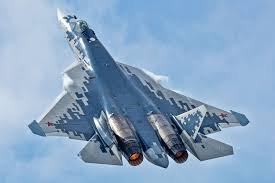
After submitting a thorough technical assessment to Hindustan Aeronautics Limited, a Russian delegation made up of representatives from the Sukhoi Design Bureau and other defense agencies came to the conclusion that the state-owned aerospace company has about half of the manufacturing capacity needed to co-produce Russia’s Su-57E, the export version of its fifth-generation stealth fighter aircraft.
This assessment indicates that India is on the verge of becoming one of a very select group of nations that are able to produce cutting-edge stealth combat aircraft, marking a potentially revolutionary moment in the country’s defense industrial and geopolitical stance. The
The Russian evaluation, carried out in September 2025 in advance of President Vladimir Putin’s planned December visit to India, is the result of in-depth inspections to three crucial HAL sites that together serve as the foundation of India’s developing aerospace industry.
Because of its extensive heavy manufacturing infrastructure, advanced computer numerically controlled machining centers, extensive quality assurance laboratories, and large assembly hangars, the Nashik division—which currently produces the Sukhoi Su-30MKI for the Indian Air Force—was deemed especially suitable for Su-57E airframe production.
The Russian engineers pointed out that starting Su-57E structural manufacturing operations at Nashik would require very little retrofitting.
Beyond Nashik, the delegation visited the Strategic Electronics Factory in Kasaragod, Kerala, which specializes in the assembly, testing, repair, and manufacturing of cutting-edge airborne computer systems necessary for the integration of contemporary fighter aircraft, and the Koraput division in Odisha, which produces the AL-31FP aero engines that power the current Su-30MKI fleet. The
The 50% capacity finding highlights HAL’s current technological preparedness in a number of crucial areas that form the basis of the production of fifth-generation aircraft. HAL has functional competence in airframe manufacture, engine assembly operations, advanced avionics integration skills, and materials processing processes that are in line with stealth-oriented fabrication requirements, according to the Russian technical assessment.
In order to reach full production capability, the assessment concurrently identifies significant gaps that need to be filled through focused investment and capability growth. The remaining 50% of the necessary capacity is spread over a number of interrelated fields that call for large investments, R&D costs, and labor growth.
HAL is currently working on a comprehensive assessment that it will submit to the Defense Ministry. This assessment will outline the specific capital investments needed for modernizing infrastructure, expanding and specializing research and development facilities, acquiring cutting-edge manufacturing equipment, and hiring and training more qualified staff.
The development of specialized facilities for the fabrication of low-observable composites, the creation of secure coding environments for fifth-generation avionics software systems, the establishment of advanced sensor fusion laboratories, and the development of multi-band active electronically scanned array radar calibration capabilities are just a few of the areas that the Russian report identified as needing attention. The
Given the 2018 collapse of discussions over the Fifth-Generation Fighter Aircraft program, Russia’s offer to India to co-produce the Su-57E is fundamentally different from earlier collaborative defense initiatives between the two countries.
Russia’s current proposal includes comprehensive provisions addressing these long-standing obstacles, whereas India’s previous engagement with Russia on fifth-generation fighter development failed due to disagreements regarding technology transfer, intellectual property rights, stealth performance specifications, and cost-sharing arrangements.
Unrestricted technology transfer of vital fifth-generation technologies, such as engines, sophisticated optics systems, active phased-array radar architectures, AI algorithms incorporated into weapons systems, low-signature stealth technologies, and contemporary air weapons platforms, has been specifically committed to by Moscow.
Additionally, Russia is offering joint intellectual property rights agreements and source code access, allowing India to incorporate domestic weaponry systems like the Rudram anti-radiation missile family, the BrahMos cruise missile variants, and the Astra air-to-air missile family into the aircraft. The
The Su-57E is a powerful multi-role combat vehicle with a number of cutting-edge technological innovations that set fifth-generation fighter aircraft apart from earlier models.
The development of India’s domestic Advanced Medium Combat Aircraft program, which reflects the country’s long-term goal of achieving total self-reliance in fifth-generation fighter development and manufacturing, has been concurrently committed to by the defense policy. The IAF has stated that the AMCA program, which is being developed by ADA and HAL, is still on track for its first flight in 2028 and operational induction by 2035. This will herald India’s expected entry into fifth-generation combat capability through domestic development.
Due to the fact that India’s immediate operational needs for fifth-generation aircraft significantly predate the availability of the domestic AMCA platform, this timeline creates a strategic conundrum whereby India lacks a domestically developed fifth-generation fighter capability for a number of years. The
India’s choice on the Su-57E proposal is based on a strategic calculus that takes into account a number of conflicting factors that go beyond specific defense industry criteria. The Su-57E’s immediate availability, according to supporters, fills critical operational gaps in the Indian Air Force, stops the fighter squadron strength from declining further, and gives India proven fifth-generation combat capability while the AMCA program develops.
The possibility of unrestricted technology transfer in crucial areas like engines, stealth technologies, radar systems, and artificial intelligence components offers India a once-in-a-lifetime chance to boost its technological independence and build a strong domestic fifth-generation fighter industrial ecosystem that can support both the AMCA program and successor platforms that extend into the sixth-generation fighter domain. The
The
While positive, the Russian delegation’s evaluation of HAL’s 50% preparedness for Su-57E production also highlights the substantial infrastructure and financial needs that would come with any choice to move forward with local manufacturing.
Any choice pertaining to Su-57E manufacturing will have far-reaching effects that go well beyond specific defense considerations. These include supply chain development, industrial policy aspects, technology absorption methods, and the long-term future of India’s aerospace industry.