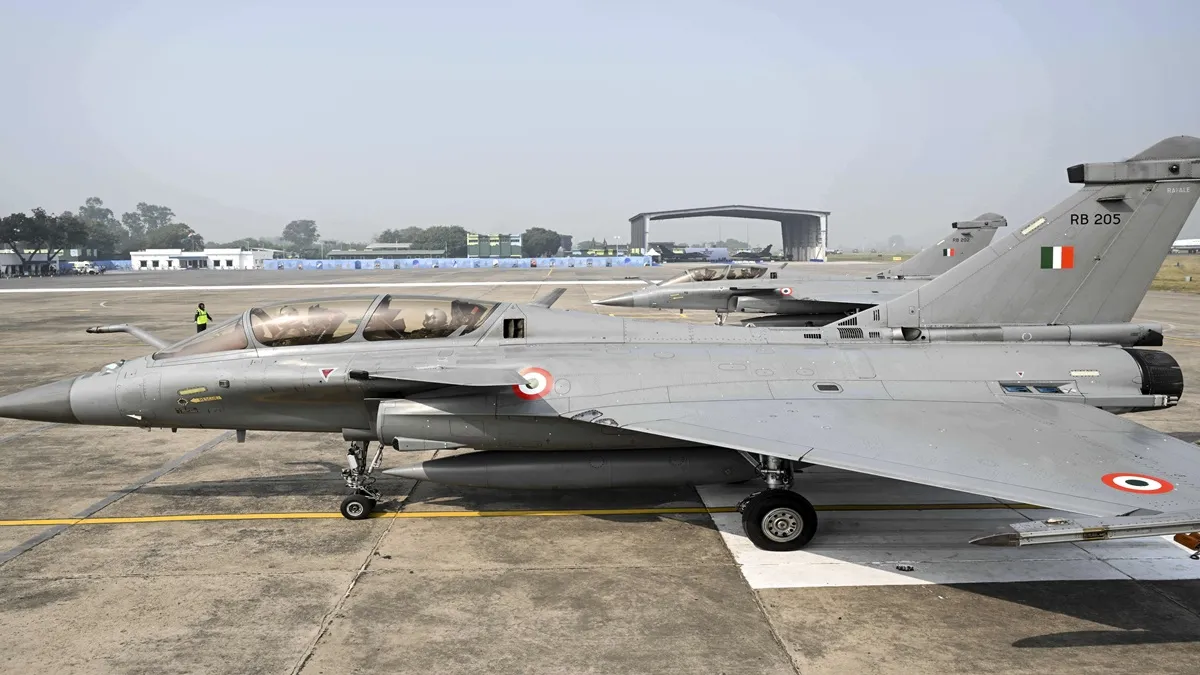
In order to equip the Indian Air Force’s Rafale fighters with more Meteor air-to-air missiles (AAM), the Defence Acquisition Council (DAC) has awarded Acceptance of Necessity (AoN).
This decision, which was approved at the DAC meeting on December 29, 2025, highlights India’s efforts to improve its beyond-visual-range (BVR) combat capabilities in the face of changing regional threats.
The sanction is a component of larger purchases totaling about ₹79,000 crore that are intended to improve the operational preparedness of the armed services.
With its solid-fuelled ramjet propulsion that allows for sustained supersonic speeds beyond Mach 4 and a range of more than 200 kilometers, the Meteor missile, produced by Europe’s MBDA consortium, represents a breakthrough in air-to-air warfare.
Its throttleable ducted rocket, which offers a no-escape zone three to six times greater than rivals like the AIM-120 AMRAAM, offers improved kinematic performance in contrast to conventional rocket-powered missiles. Even in circumstances with a lot of electronic countermeasures, this active radar-guided BVRAAM performs exceptionally well against highly maneuverable targets like planes, UAVs, and cruise missiles.
The 36 Rafale aircraft that India purchased from France in 2016 were the first to have Meteor missiles, making them the only platform that the IAF is currently able to use. The fleet’s long-range strike edge would be strengthened by the additional batch, which is anticipated to contain about 80 missiles and cost about ₹1,500 crore. Meteor’s role in maritime operations will be expanded with future integration for the Indian Navy’s upcoming 26 Rafale Marine aircraft.
Meteor’s strategic worth over medium-range alternatives is highlighted by this acquisition, which is in line with lessons learned from Operation Sindoor, where long-range standoff weapons proved crucial against Pakistani targets.
The missile’s two-way datalink improves salvo-fire efficacy in contested airspace by allowing mid-course updates and retargeting from the launch aircraft or networked assets. Meteor fills important holes in the IAF’s BVR armament while domestic ASTRA MK-2 development is delayed.
With China’s J-20 stealth planes and PL-15 missiles posing a threat to superiority along the Line of Actual Control and Pakistan’s improved F-16s carrying extended-range ordnance, regional rivals present serious concerns.
Rafales can engage enemies beyond their retaliatory reach because to Meteor’s ramjet endurance, ensuring air superiority in the Indo-Pacific theater. By countering these asymmetries, the agreement discourages adversaries with numerically superior but less sophisticated platforms from taking risks.
Given past MBDA qualification, procurement proceeds through the regular DAC procedure, moving from AoN to staff review, field trials, and contract negotiation under the Buy Global route.
In order to overcome squadron shortages, quick delivery is prioritized without regard to offsets or obligations for indigenous content. Bulk pricing is reflected in the ₹1,500 crore outlay; after discounts, each missile costs roughly ₹18–19 crore.
Building on Meteor’s operational success with Gripen, Rafale, Typhoon, and new F-35 integrations, MBDA’s European partners—the UK, Germany, Italy, France, Sweden, and Spain—benefit from continuous manufacturing. The supply chain is maintained by India’s order, which may facilitate exports to countries that are aligned. IAF maintenance costs are reduced by the missile’s 1,000-hour transport life and containerized logistics.
With ASTRA MK-2 and MK-3 under DRDO development to eventually equip TEJAS and Su-30MKI platforms, indigenization continues to be a concurrent priority. But Meteor’s track record of dependability fills in the gaps, enhancing Rafale’s multi-role capabilities with SCALP cruise missiles. This hybrid strategy strikes a balance between Atmanirbhar’s missile technology aspirations and import reliance.
Following the Rafale agreements, the DAC permission suggests expedited 2025 procurements, including ASTRA MK-2 alongside Meteor, strengthening India-France relations. Europe’s dependability as a supplier becomes more important to Delhi as President Trump directs US policy. By 2027, delivery schedules might coincide with Rafale F4/F5 discussions, strengthening IAF’s competitive advantage.
This AoN ensures credible deterrence in the unstable skies of South Asia by strengthening Rafale squadrons against peer threats. Rapid fielding will put the procurement efficiency refined under recent reforms to the test in the face of ambient tensions.