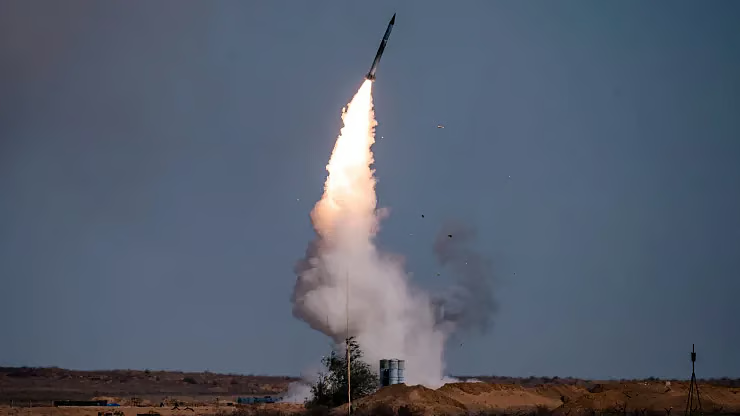
According to Zee News, the Defence Research and Development Organization is creating a customized version of the ASTRA MK-2 air-to-air missile as part of India’s efforts to advance its stealth fighter and combat drone projects.
In order to fit inside the internal weapons bays of upcoming stealth platforms like the Advanced Medium Combat Aircraft and the Ghatak unmanned combat aerial vehicle, this updated model has folding fins.
Because external carriage increases radar exposure and compromises stealth advantages, the project has been given priority because stealth aircraft depend on carrying weapons internally. India intends to maintain stealth while guaranteeing adequate weapon capacity for combat missions by modifying the ASTRA MK-2.
While conventional missiles with fixed fins take up more room and limit internal storage, stealth planes rely on smooth outside surfaces to minimize radar detection. DRDO engineers have developed a spring-loaded folding fin device to get around this.Defense policy of the ministry
When the missile is launched, the fins automatically unfold, stabilizing it and directing it in the direction of its target while remaining folded against the missile body within the aircraft. This invention enables stealth aircraft to store more missiles inside while saving room without sacrificing performance.
The AMCA’s internal firepower is anticipated to be greatly increased by the folding-fin design. The aircraft’s small size currently permits it to carry up to six ASTRA MK-2 missiles, whereas earlier estimates indicated it could only carry four.
Pilots can now engage several targets while rem
aining stealthy thanks to this enhancement. In order to fit the updated missile, the Aeronautical Development Agency is collaborating with DRDO to fine-tune the AMCA’s internal bay dimensions.
An important stage in integration was reached in late 2025 when high-speed separation tests verified the missile could be safely released at supersonic speeds without jeopardizing the aircraft.
The Ghatak unmanned combat aerial vehicle, often referred to as the Remotely Piloted Strike Aircraft, is being developed using the same technology.
The modified ASTRA MK-2 will be carried internally, enabling the drone to defend itself against opposing aircraft while operating in hostile airspace. This stealth flying-wing drone is intended for deep-strike missionsAfter the Defence Acquisition Council authorized the purchase of four drone squadrons in March 2026, integration efforts quickened.
The ASTRA MK-2 provides improved combat performance in addition to its foldable fins. It has a strike range of 160 to 200 kilometers thanks to its dual-pulse solid rocket motor. In order to intercept maneuvering targets, the second pulse delivers more speed and energy during the latter stage of flight.
Its capacity to combat evasive aircraft is enhanced as a result. Additionally, the missile has a Ku-band active radar seeker that was created in India, supporting the country’s efforts to build its own defense capabilities.
The development of the ASTRA MK-3, also known as Gandiva, which is being created especially for stealth platforms, is also being influenced by the folding-fin concept. This missile’s Solid Fuel Ducted Ramjet propulsion system was successfully tested in flight at Chandipur in April 2026.
The device maintains supersonic speeds up to Mach 4.5 by enabling thrust modulation throughout flight. The ASTRA MK-3, which has a range of 300 to 350 kilometers, is anticipated to target valuable assets like mid-air refuellers and airborne early warning aircraft.
The folding-fin ASTRA MK-2 and the upcoming ASTRA MK-3 together mark a significant advancement in India’s efforts to develop missile systems that are compatible with stealth.India’s foreign policy
Future air combat and deep-strike capabilities will be strengthened by these improvements, guaranteeing that India’s next-generation platforms will function successfully in disputed areas while retaining stealth advantages.
.