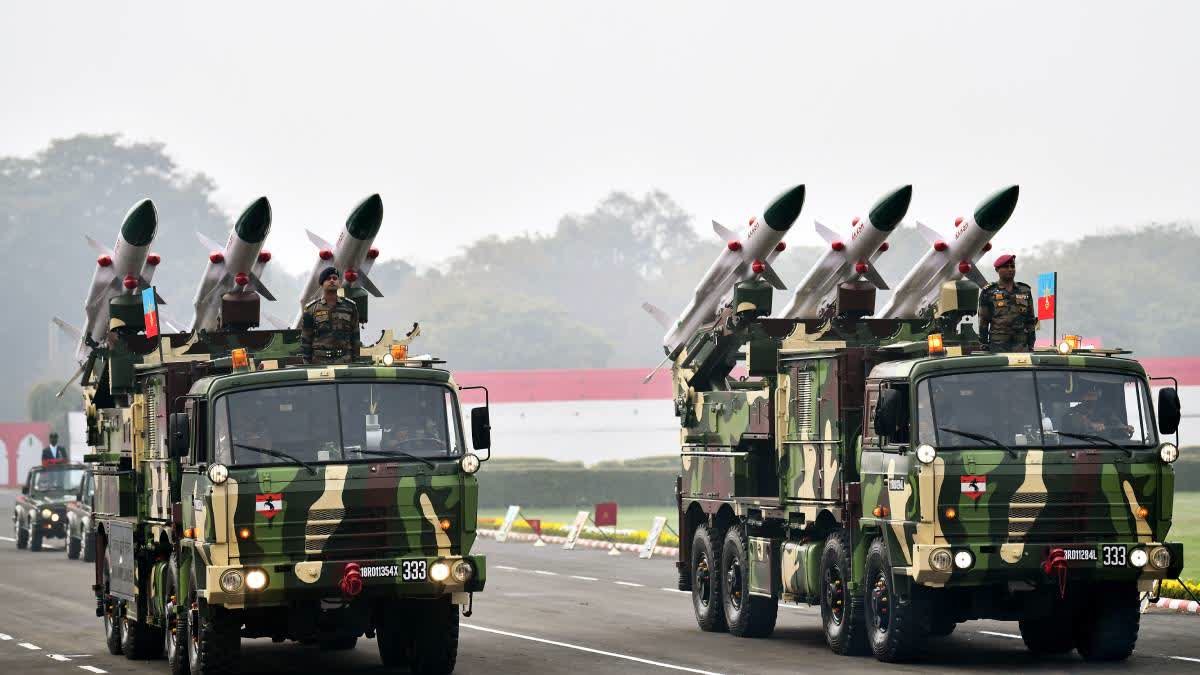
Following the system’s combat success during Operation Sindoor in May 2025, India has started a massive expansion of its domestic Akash surface-to-air missile (SAM) production.
During the cross-border escalation, several Pakistani short-range ballistic and cruise missiles were successfully intercepted by the dual-armed Akash batteries of the Indian Air Force and Army. This was the first significant operational validation of the system’s full combat capacity.
The main manufacturer of the Akash missile system, Bharat Dynamics Limited (BDL), is now expanding assembly lines at its Bhanur and future Jhansi sites.
Rebuilding strategic reserves, equipping more Indian Army and IAF regiments, and maintaining committed export orders are the objectives of the endeavor. In order to facilitate faster delivery, partner businesses like Bharat Electronics Limited (BEL), Larsen & Toubro (L&T), and TATA Advanced Systems are increasing parallel manufacturing of radars, launchers, and command networks.
According to defense sources, in order to improve layered air defense coverage over the northern and western sectors, the Ministry of Defense has approved an expedited procurement of new Akash-1S and Akash-NG models.
While the Akash-NG has a solid-fuel ducted ramjet (SFDR)-based propulsion engine that offers engagement ranges of up to 70 km, the Akash-1S, which has an indigenous AESA seeker, offers better accuracy versus low-RCS targets.
To enable automatic threat correlation and real-time engagement decisions, the Defense Research & Development Organization (DRDO) and BDL are working together on modular upgrades to connect Akash systems with the Integrated Air Command and Control System (IACCS).
In order to strengthen the tiered response against saturation strikes, the Indian Air Force has asked for increased radar coverage and better networking with domestic systems like the Ashwini and Arudhra radars.
Southeast Asian, Middle Eastern, and African countries have shown increased interest in exporting the Akash due to its combat success.
Due to the Akash-NG variant’s competitive pricing structure and domestic technology basis, negotiations with Vietnam, the Philippines, and Armenia have accelerated. India’s standing as a reliable provider of cutting-edge air defense technology has been strengthened by the system’s proven dependability in times of war.
The government’s Atmanirbhar Bharat vision, which requires that more than 85% of the Akash system’s components come from domestic producers, is in line with the expansion effort.
Canisters, propulsion sections, seeker heads, command guidance units, and phased-array radars are examples of crucial subsystems. It is anticipated that the present scaling-up process will create a large number of jobs throughout India’s defense manufacturing ecosystem, particularly in the MSME clusters in Hyderabad, Bangalore, and Nagpur.
The extension of the Akash program is seen by strategic planners as a crucial step toward developing autonomous air defense capacity in the face of growing regional threats.
With China bolstering its western theater defenses and Pakistan building up its missile and drone stockpiles, India’s focus on sustained domestic SAM manufacturing highlights a calculated pivot towards long-term deterrent stability.