The deployment of Ghatak, India’s first domestic stealth unmanned combat aerial vehicle, has advanced significantly. The Indian Air Force’s purchase of Remotely Piloted Strike Aircraft, which includes UCAVs, was authorized by the Defense Acquisition Council on March 27.
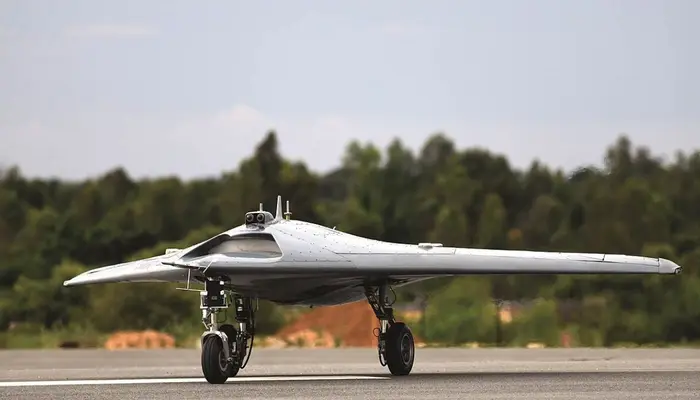
The Aeronautical Development Establishment of the Defense Research and Development Organization created the Ghatak drone, which is remarkably similar to the American B-2 Spirit stealth bomber.
It is a component of India’s long-term Vision 2047 plan, which aims to improve capabilities for coordinated operations with fighter aircraft like the TEJAS, deep strike missions, and the suppression of enemy air defenses.
The initiative, which was formerly known as AURA, or Autonomous Unmanned Research Aircraft, is an indication of India’s resolute efforts to create an indigenous next-generation stealth combat drone. The UCAV is a pilotless aircraft propelled by a 13-ton class jet. Eighty to ninety percent carbon-fibre prepreg composites are anticipated to make up its exterior shell, a design decision that improves its radar-evading capabilities.
The aircraft’s low-observability design and domestically produced dry Kaveri engine allow it to function well in contested airspace while reducing detection. Ghatak, in contrast to traditional fighter jets, uses a tailless flying-wing structure, which was chosen especially to lessen its radar signature and aid in its concealment from enemy observation systems.
In order to maintain its stealth profile, the indigenous UCAV is built to carry up to 1.5 tons of weaponry, which will be kept in internal weapon bays. The aircraft is a powerful addition to India’s aerial combat inventory because of this capabilities, which guarantees that it can deliver precise hits while retaining its low-visibility edge.
In order to improve stealth and survivability against sophisticated adversary air defense systems, Ghatak UCAV will include an indigenous miniaturized Active Electronically Scanned Array (AESA) radar with Low-Probability-of-Intercept (LPI) technology. With the use of this radar, the UCAV will be able to monitor and identify targets while reducing the possibility that enemy sensors may detect its emissions.