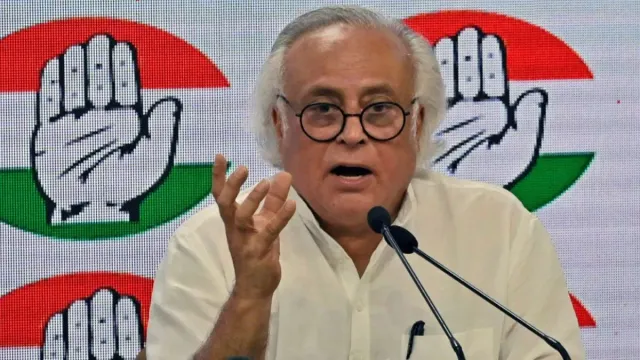
Following Chinese Foreign Minister Wang Yi’s assertion that Beijing mediated the India-Pakistan conflict during Operation Sindoor in May 2025, Congress MP Jairam Ramesh has harshly criticized the Central government.
Ramesh called the claim a “joke of our national security,” emphasizing China’s strong military links to Pakistan and its position as Islamabad’s main source of weapons.
The issue began on April 22, 2025, when 26 people were killed in a terror assault in the Pahalgam valley of Jammu and Kashmir. As a result, India launched Operation Sindoor on May 7.
New Delhi described the missile and air attacks carried out by Indian troops against terrorist infrastructure associated with Jaish-e-Mohammed, Lashkar-e-Taiba, and Hizbul Mujahideen in Pakistan and Pakistan-occupied Kashmir as targeted and non-escalatory.
Tensions increased during the four-day conflict as Pakistan claimed that the attacks had killed civilians. On May 10, Pakistan’s Director General of Military Operations (DGMO) allegedly asked his Indian counterpart for a ceasefire, which resulted in an agreement to stop all gunfire across land, air, and water. India asserted that no military or civilian facilities were struck.
At a conference on international issues and China’s foreign relations on December 30, 2025, Wang Yi listed mediation in the India-Pakistan tensions along with other global hotspots like the Iran nuclear problem and northern Myanmar. In order to create enduring peace, he emphasized China’s “objective and just stance” in addressing both symptoms and underlying causes.
Ramesh cited earlier assertions made by US President Donald Trump, who has stated 65 times in seven different nations that he personally used trade pressure to stop Operation Sindoor on May 10. The Congress leader questioned why China’s similar claim has not been refuted and pointed to Prime Minister Narendra Modi’s silence on these claims.
Ramesh cited Deputy Chief of Army Staff Lt Gen Rahul Singh’s July 4, 2025, comment in his X post, which stated that India faced China as well as Pakistan during the operation. Singh revealed China’s real-time assistance to Pakistan, which includes 81% of Islamabad’s military equipment, real-time updates on Indian positions, and the use of the battle as a “live lab” for weapon testing.
According to Singh, Turkey also provided Pakistan with Bayraktar drones, which complicated the dynamics on the battlefield. Ramesh demanded clarification on Beijing’s role in the truce, arguing that China’s support for Pakistan runs counter to any neutral mediation position.
India has vehemently denied reports of US and Chinese mediation, insisting that direct DGMO-level negotiations without outside intervention produced the ceasefire. New Delhi has consistently maintained that India-Pakistan issues are solely bilateral, according to official sources.
Since the Prime Minister’s June 19, 2020, statement rejecting Chinese invasions, Ramesh has further contextualized the issue within India-China ties, criticizing re-engagement as taking place on Beijing’s conditions. He emphasized persistent provocations over Arunachal Pradesh, huge trade deficits, and reliance on Chinese imports.
The incident highlights ongoing geopolitical tensions because Pakistan was largely dependent on Chinese weapons throughout the stalemate, such as J-10 fighters and PL-15 missiles. While external accusations run the risk of damaging New Delhi’s narrative of decisive action driving Pakistan to seek peace, India’s stance prioritizes military-to-military de-escalation.