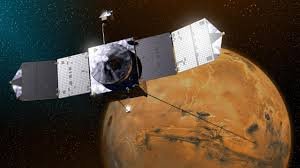
A crucial orbiter that has been researching the upper atmosphere of the Red Planet since 2014, NASA’s Mars Atmosphere and Volatile Evolution (MAVEN) probe has lost communication. Launched in November 2013 on an Atlas-V rocket, the probe traveled 502 million miles over ten months before entering Mars’ orbit in September 2014.
On December 6, 2025, during an occultation—a regular orbital pass behind Mars—there was a communication blackout. Telemetry data prior to this incident verified that all subsystems were operating normally and showed no signs of malfunction. NASA’s Deep Space Network antennae were unable to pick up any signal as MAVEN re-emerged from the far side of the planet, so mission teams launched an instant inquiry.
Before the December 20 update, no regular data had been received for around two weeks, a NASA representative acknowledged to the German news agency DPA. A brief “short fragment” of data was found by engineers, indicating that the spacecraft may have suddenly rotated, perhaps changing its orbit or orientation. Teams are analyzing monitoring data to identify the abnormality as part of ongoing efforts to reestablish contact.
The main goal of MAVEN was to learn more about how Mars’s atmosphere is stripped away by solar wind, which could help explain why the planet lost a large portion of its once-thick atmosphere and surface water billions of years ago. The orbiter has supported more than 20 peer-reviewed research over its more than ten years of operation by providing priceless data on the upper atmosphere, ionosphere, and their interactions with solar particles. Additionally, it has relayed messages for Perseverance and Curiosity, two surface rovers.
Together with orbiters like Mars Odyssey and Mars Reconnaissance Orbiter, as well as surface rovers Curiosity and Perseverance, the spacecraft continues to be a part of NASA’s active Mars fleet. Although redundant orbiters lessen the immediate effects on surface missions, MAVEN’s possible loss interrupts not just atmospheric research but also relay capability for rover data transfer.
A power malfunction, temperature problems from extended exposure, or an onboard failure that triggers safe mode—a shutdown of non-essential systems—are among the potential causes under investigation. The sudden rotation shown by telemetry may be the result of an improper momentum wheel desaturation maneuver or issues with attitude control. Even though fuel supplies were thought to be adequate for prolonged operations, NASA has not ruled out orbital degradation after 11 years.
The Deep Space Network’s antennae in California, Spain, and Australia are used to direct recovery operations from Earth, monitoring various frequencies and orbits for any weak signals.
Controllers may continually hail MAVEN until it responds if it has entered safe mode on its own. Prolonged silence increases concerns about irreversible loss, but historical precedents, such as recoveries from similar errors on prior probes, provide cautious confidence.
This incident highlights the dangers of long-duration deep-space missions, where aging hardware is subject to heat strains and cumulative radiation damage. MAVEN was extremely tenacious in the hostile environment of dust storms and solar flares on Mars, outlasting its original two-year mission by almost ten years. Future missions like ESCAPADE will be impacted by its data, which has changed our understanding of the evolution of planetary habitability.
Despite this setback, NASA’s Mars Exploration Program is still going strong, with orbiters offering overlapping coverage and Perseverance actively sampling for return flights. As examination continues, updates on MAVEN’s status are anticipated, with mission managers giving signal reacquisition top priority in order to preserve its scientific legacy.