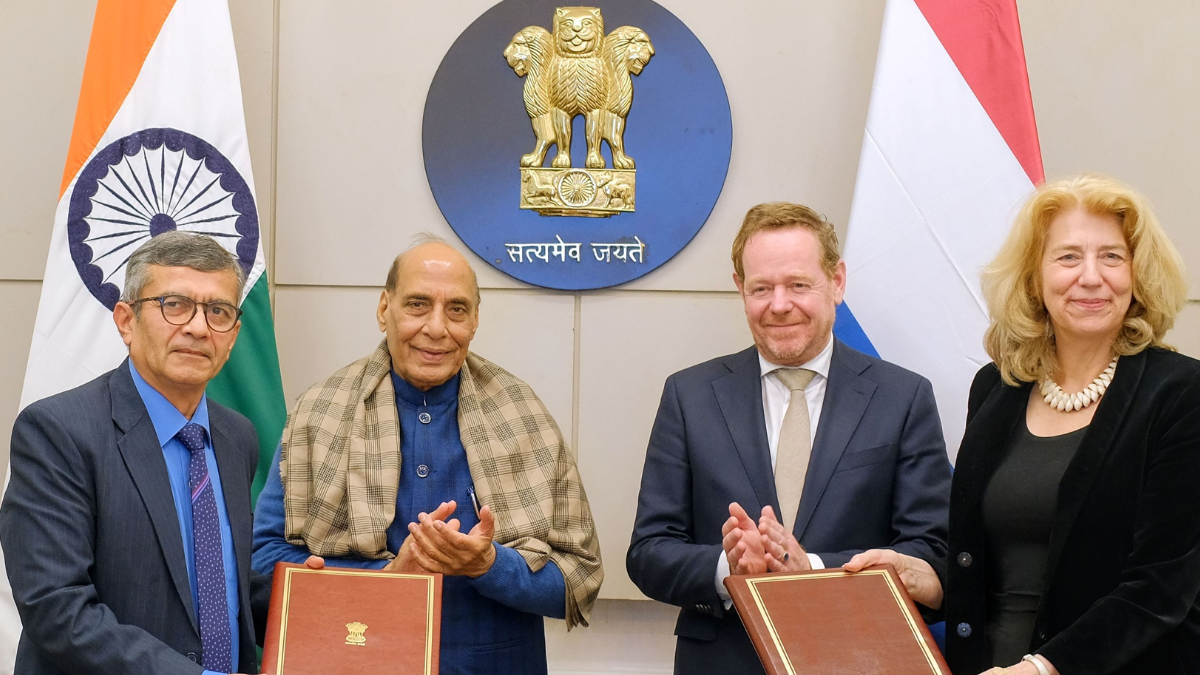
On December 18, 2025, India’s defense minister Rajnath Singh and the Netherlands’ foreign minister David Van Weel met in New Delhi, highlighting the two countries’ growing defense cooperation.
The Ministry of Defence emphasized that the talks confirmed the strong and growing relationship in defense and security areas.
With a focus on priority areas for co-development and co-production of defense equipment, both ministers examined important bilateral concerns.
They reaffirmed their determination to strengthen military-to-military cooperation, establishing defense cooperation as a pillar of India and the Netherlands’ larger Strategic Partnership.
In light of shifting regional dynamics, the leaders emphasized their common commitment to promoting an Indo-Pacific region that is free, open, inclusive, and rules-based—a crucial strategic objective.
In a significant breakthrough, the Netherlands’ ambassador to India, Marisa Gerards, and India’s defense secretary, Rajesh Kumar Singh, exchanged a Letter of Intent on Defense Cooperation in front of each other.
By focusing on mutual benefits through a suggested Defense Industrial Roadmap, this agreement opens the door for both nations to explore prospects in defense collaboration.
Along with co-production and co-development of platforms and equipment in designated domains, the strategy will focus on technology collaboration.
Strong people-to-people ties exist between India and the Netherlands, according to Rajnath Singh, who cited the sizeable Indian diaspora in the Netherlands as a crucial link promoting long-lasting friendship.
Earlier that day, Foreign Minister David Van Weel arrived in India. He has appointments in Mumbai and New Delhi to strengthen bilateral ties.
Van Weel was greeted on X by Randhir Jaiswal, a spokesperson for the Ministry of External Affairs, who said that the visit is intended to strengthen and broaden connections between the Netherlands and India.
This high-level engagement indicates continued momentum in high-level engagements and comes ahead of the Netherlands Prime Minister Dick Schoof’s planned visit in February 2026.
The meeting may create opportunities for cooperative ventures in specialized technology and is consistent with India’s ‘Make in India’ policy and indigenization efforts in defense industry.
By utilizing the Netherlands’ proficiency in high-precision engineering, these partnerships might cover cutting-edge fields like sensor technology, maritime systems, or aircraft components.
By expanding its defense industrial ecosystem beyond conventional allies, this alliance helps India’s supply networks become more resilient in the face of global geopolitical upheavals.
Under the Atmanirbhar Bharat framework, the focus on linking the two countries’ defense industry promises technology transfers that could hasten India’s aspirations for self-reliance.
Through improved interoperability and cooperative capabilities, the shared vision promotes stability in the Indo-Pacific region by countering forceful postures from regional actors.
With the possibility of cooperative working groups identifying particular projects in the upcoming months, the Letter of Intent represents a formal step towards actionable solutions.
Rajnath Singh’s involvement is indicative of India’s aggressive diplomacy in developing strategic defense alliances with European countries, enhancing relations with long-standing allies like France and Russia.
This collaboration may include cooperative drills, intelligence sharing, and humanitarian relief efforts as the Netherlands expands its Indo-Pacific footprint.
According to Singh, the diaspora connection adds a cultural element, with more than 2,50,000 Indians living in the Netherlands strengthening social and economic ties.
The scope is further expanded by Van Weel’s travel to Mumbai, where he may interact with India’s commercial centers for industry matchmaking and defense offset opportunities.
With real operational and industrial benefits on the horizon, this move puts defense relations between the Netherlands and India on a path of strategic convergence.