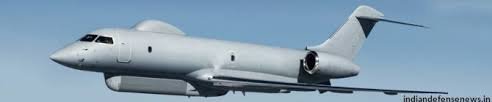
As part of the DRDO ISTAR program, the Indian Air Force (IAF) is starting a ground-breaking project by transforming the opulent Bombardier Global-6500 business jet into a powerful airborne battle manager.
The IAF now has a platform that can coordinate intricate battlefield scenarios from standoff distances, marking a strategic shift from luxurious business travel to high-stakes military operations.
Fundamentally, the Global-6500 is perfect for continuous surveillance over India’s extensive borders and maritime domains because of its remarkable range of over 12,000 kilometers and endurance of up to 15 hours.
Originally built for VIP comfort, its roomy fuselage now houses a variety of domestic avionics, including as Active Electronically Scanned Array (AESA) radars and electro-optical/infrared (EO/IR) sensor suites created by DRDO’s labs.
By combining data into a full battlespace image, these sensors allow real-time tracking of adversary aircraft, missiles, drones, and ground units. The aircraft incorporates secure datalinks that meet India’s military requirements, enabling smooth communication with resources including navy vessels, Tejas fighters, and S-400 air defense systems. By converting unprocessed intelligence into useful strike coordinates, this networked technique improves situational awareness.
The platform fills important gaps in India’s airborne early warning and control (AEW&C) capabilities under the ISTAR (Intelligence, Surveillance, Target Acquisition, and Reconnaissance) umbrella. The Global-6500 uses conformal arrays for 360-degree coverage without sacrificing aerodynamics, which lessens vulnerability to enemy fire while retaining stealthy profiles, in contrast to conventional AWACS with rotating radomes.
This project is driven by indigenization; more than 70% of the mission systems are supplied locally. In order to reduce dependency on foreign suppliers, DRDO’s Center for Airborne Systems (CABS) is in charge of integrating domestic secondary surveillance radar (SSR) and electronic support measures (ESM). This promotes independence in cutting-edge defense electronics and is consistent with the Atmanirbhar Bharat mission.
The conversion process takes place at a DRDO-HAL facility, where the jet is electromagnetically hardened, structurally reinforced for massive sensor payloads, and self-protection suites like as directional infrared countermeasures (DIRCM) and missile approach warners are installed. In order to prepare for introduction by 2028, flight testing are scheduled for late 2026.
In terms of operations, the Global-6500 will act as a force multiplier along the Line of Control (LoC) with Pakistan and the Line of Actual Control (LAC) with China. By using low-observable features and electronic warfare jammers to avoid detection, it may loiter at high altitudes and cue BrahMos supersonic cruise missiles or Rudram anti-radiation weapons fired from Su-30MKI fighters.
By keeping an eye on the Indian Ocean Region (IOR), Chinese naval activities close to the Malacca Strait, and Pakistani submarines in the Arabian Sea, it supports the Indian Navy’s blue-water aspirations. Rapid reaction to threats is made possible by integration with the Integrated Air Command and Control System (IACCS), which guarantees data transfers to ground stations.
This platform combines greater endurance with battle management software derived from DRDO’s Netra Mk1A to outperform competitors’ equivalents, such as China’s KJ-500 or Russia’s A-100. The sensor-to-shooter death chain is shortened by sophisticated AI algorithms that scan multi-sensor feeds, anticipate adversary maneuvers, and automate danger prioritization.
The project’s cost-effectiveness highlights its attraction; the estimated cost of purchasing and modifying six Global-6500s is less than $1.5 billion, which is significantly less than the cost of custom AWACS developments. By utilizing commercial off-the-shelf (COTS) airframes, this expedites schedules and provides funding to the Indian aerospace industry, which includes private companies such as Tata Advanced Systems.
Geopolitically, the ISTAR program, in which Bombardier (now part of Spirit AeroSystems) collaborates through offsets, signifies strengthening defense connections between the United States and India. Despite conflicts with Beijing, it maintains strategic autonomy through co-developed communications protocols between Russia and India, balancing multipolar partnerships.
There are still issues, such as maintaining interoperability with traditional IAF equipment and strengthening cybersecurity against quantum threats. DRDO uses quantum-resistant encryption and red-team exercises to mitigate threats, learning from recent wars such as that in Ukraine.
In the end, the Global-6500’s transition from business jet to battle manager ushers in a new era for the IAF by combining lethal prowess with luxury heritage. It strengthens India’s deterrence stance, improves the effectiveness of real-time command, and serves as an example of how commercial aviation and domestic innovation may coexist in contemporary combat.