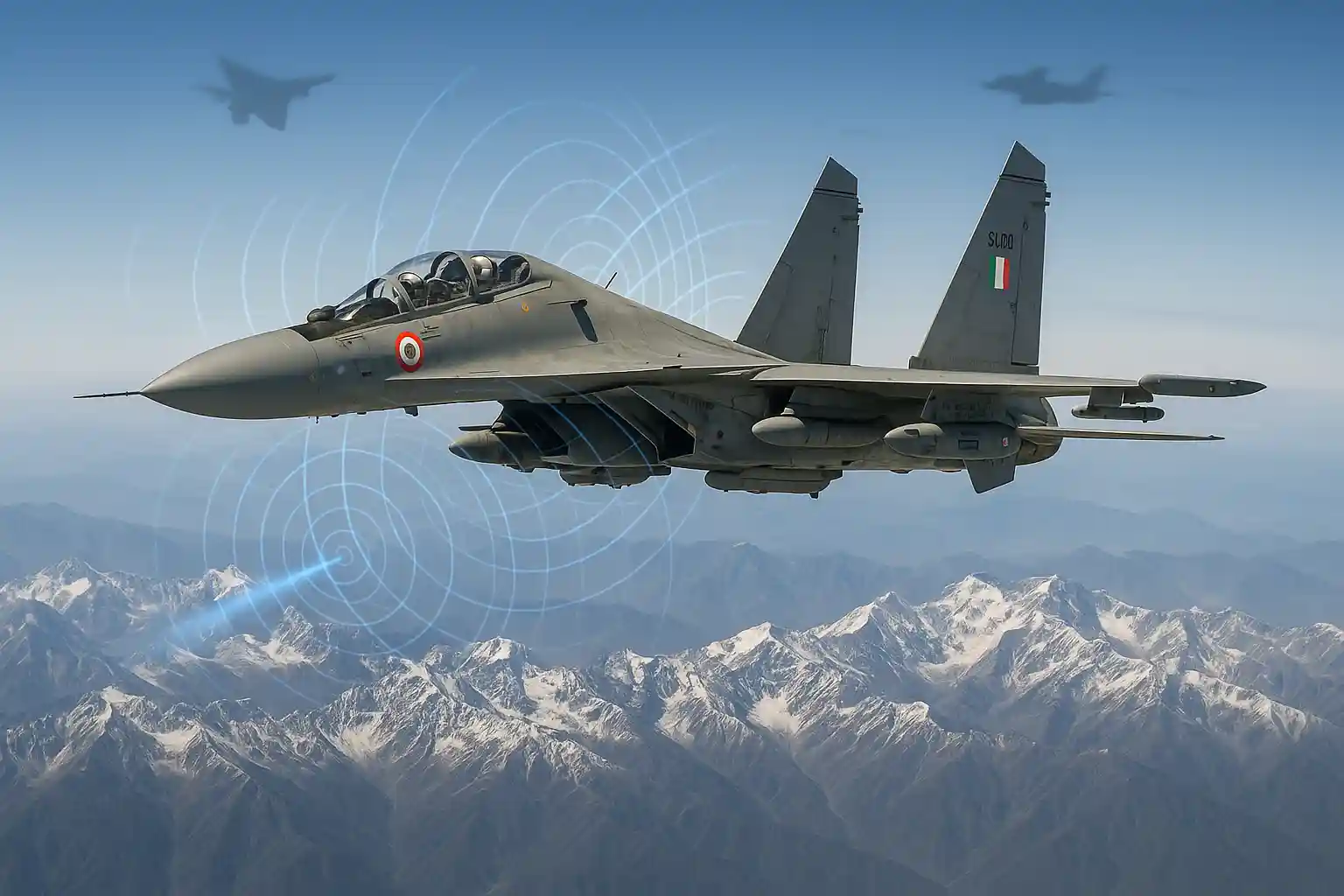
India has finalized a $1.2 billion deal to purchase approximately 300 Russian R-37 million very long-range air-to-air missiles for its Su-30MKI fleet. This decision highlights tensions with France over the transfer of Rafale technology while strengthening immediate air dominance.
The missiles will act as a temporary solution until domestic Astra Mk-II and Mk-III systems are developed, and deliveries are anticipated in 12 to 18 months.
A deal worth more than $1 billion has been inked by India to buy a sizable number of Russian R-37M long-range missiles. The agreement reportedly covers 300 missiles for around $1.2 billion, and delivery are anticipated to start in 12 to 18 months.
These missiles will be installed aboard India’s Su-30MKI fighters, which make up the core of the Indian Air Force together with French Rafales.
The R-37M, also referred to as a “AWACS killer,” has a 60-kilogram warhead, a maximum launch range of 300–400 kilometers, and a flight speed of up to Mach 6. It uses an active radar seeker in the terminal phase and inertial navigation with radio correction in the midcourse phaseThe missile is intended to change the balance of power in disputed airspace by neutralizing high-value airborne assets like electronic warfare platforms, aerial refuellers, and surveillance aircraft.
Operation Sindoor, which revealed India’s beyond-visual-range deficiency against Pakistan’s PL-15 missile, served as the basis for the decision. Only software updates to the Bars radar on the Su-30MKI are needed to integrate the R-37M, avoiding expensive structural changes.
While domestic Astra MK-II and MK-III missiles are being developed, this acquisition gives India a bridging capability. India’s future BVR arsenal is anticipated to be built on the Astra series, but in the meantime, the R-37M provides a solid temporary fixThe agreement coincides with rumors that India may decide not to proceed with its intended acquisition of 114 Rafale aircraft. India insists on integrating domestic weapons like Astra and BrahMos-NG without French oversight, while France has refused to grant access to the Rafale’s Interface Control Document.
Every improvement would need French consent in the absence of ICD access, weakening operational sovereignty. The $43 billion Rafale contract is now in jeopardy because to this conflict, with India threatening to withdraw if its demands are not satisfiedA $25 billion procurement plan encompassing all military branches was authorized by the Indian government earlier this year. Additional Russian S-400 surface-to-air missile systems, medium transport aircraft, and strike drones are scheduled to be delivered to the Indian Air Force. The package also includes the modernization and overhaul of Su-30MKI engines, with Russia providing AL-41F1S and 177S alternatives to replace the outdated AL-31FP engines.
In order to maintain the Su–30MKI as a reliable front-line platform, these improvements are intended to increase service life, boost thrust, and lower fuel consumptionFrom a strategic standpoint, the R$37 million purchase puts India in a position to equal the growing reach of the American AIM$174B and fight China’s PL$17. By fielding this missile, India strengthens deterrence in South Asia by increasing its capacity to prevent adversaries from using force and multiplying airborne assets.
.
.
.
.