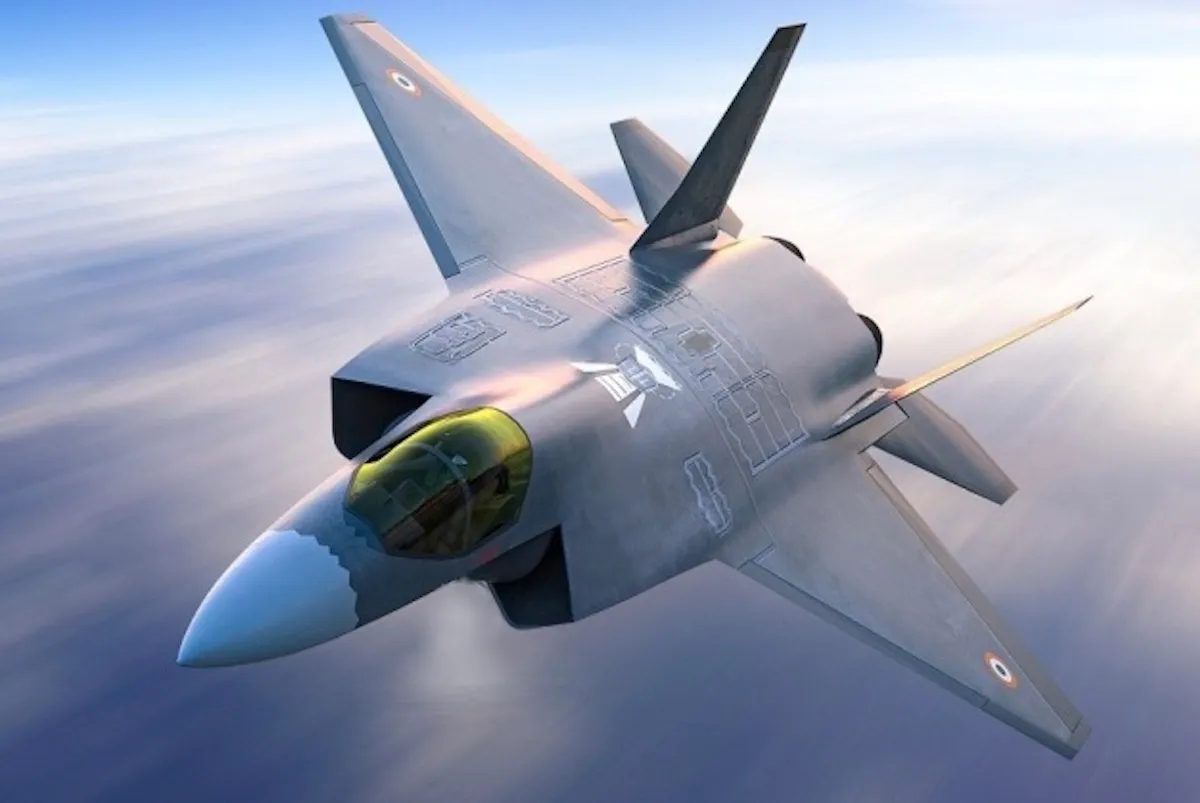
With prototypes anticipated by 2028–2029 and induction around 2034–2035, India’s Advanced Medium Combat Aircraft (AMCA) is developing as the most surprising stealth fighter ready to challenge China’s J-20 dominance.
As a strategic underdog with worldwide ramifications, the program has grown to a projected fleet of 250 aircraft, incorporating fifth-generation characteristics and even sixth-generation technologies.
India’s AMCA project started out as a daring goal to become one of the few countries that can produce fifth-generation stealth warplanes. Even though conceptual development began in the late 1970s, there are now just four of these aircraft being produced globally.
With features like supermaneuverability, supercruise, stealth shaping, radar-absorbent materials, and cutting-edge networking systems, the AMCA is intended to bring India into this exclusive group. Future iterations are rumored to include sixth-generation technologies like AI-assisted mission computing and the integration of faithful wingman drones.
In recent years, the program has accomplished significant milestones. A ₹15,000 crore prototype phase was approved; the maiden flight is anticipated by 2028–2029, and rollout is scheduled for 2026–2027.
Hindustan Aeronautics Limited (HAL) and the Aeronautical Development Agency (ADA) are in charge of development, but a new competitive framework has made it possible for private behemoths like TATA, Larsen & Toubro, and Adani to take part, shattering HAL’s monopoly and spurring innovation.
Long-term policy now envisions a 250-strong stealth fleet, whereas the Indian Air Force (IAF) originally planned for just 120 aircraft. This expansion is driven by the need to replace legacy Su-30MKI fighters in the 2040s and to counter China’s rapidly growing J-20 fleet, estimated at 200–250 aircraft.
GE F414 engines will power the AMCA MK-1, while a co-developed Indo-Safran engine with 110–120 kN thrust will power the MK-2 and allow for complete supercruise capability. With engines in the 120–140 kN class, an MK-2+ variant is anticipated to significantly improve performance.
Suppression and Destruction of Enemy Air Defenses (SEAD/DEAD) missions, especially against sophisticated Chinese systems like the HQ-9, are centered around the AMCA according to operational doctrine. India hopes to establish air superiority in disputed areas like Ladakh and Arunachal Pradesh by deploying stealth squadrons tasked with destroying surface-to-air missile networks.Perspectives on the Indian Economy
The AMCA will be able to function covertly in high-threat areas thanks to its internal weapons bays, sophisticated AESA radar, and sensor fusion.
The initiative also represents India’s defense push for Aatmanirbhar Bharat, or self-reliant India. The AMCA lessens dependency on foreign suppliers by incorporating domestic composites, avionics, and radar-absorbent materials. In addition to being a scientific advancement, its creation is a strategic declaration of India’s intention to keep parity in the Indo-Pacific theater and equal China’s aerospace advancements.
The AMCA is no longer a far-off dream, from the planning board to the skies. With production frameworks in place and prototypes getting closer to completion, India’s stealth fighter is poised to emerge as the surprising underdog that might completely alter the balance of air power in the area.