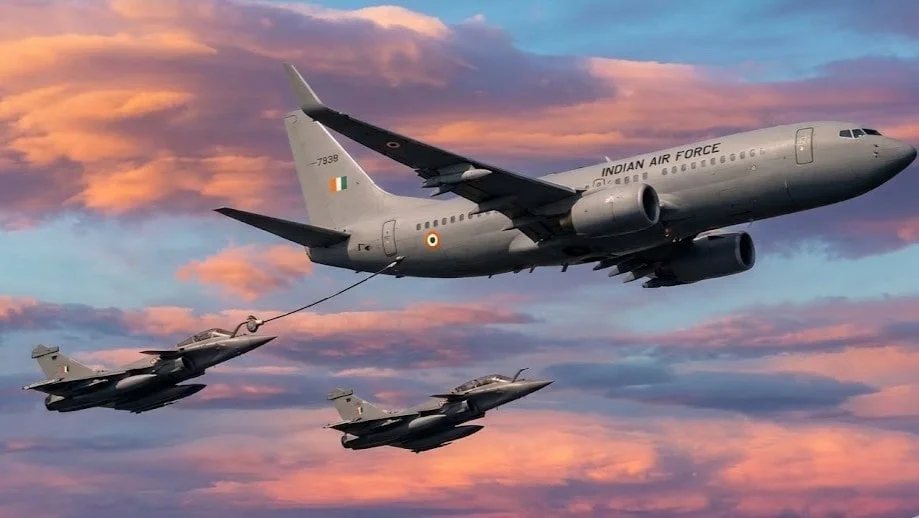
By approving the conversion of six pre-owned Boeing 767s into Multi-Mission Tanker Transports (MMTTs, valued at $900m–$1.1bn) in collaboration with Israel Aerospace Industries (IAI) and Hindustan Aeronautics Limited (HAL), India has finally broken a two-decade impasse in aerial refueling procurement.Pakistan-India Relations
This sensible decision incorporates “Make in India” industrial engagement while avoiding the exorbitant costs of Boeing KC-46s and Airbus A330 MRTTs.
The Indian Air Force relied on aging Russian Il-78MKI tankers for more than 20 years, however these vehicles had limited availability and high maintenance expenses. Several attempts to get replacements from the West failed.
With its A330 MRTT, Airbus won two tenders: a $1.6 billion offer in 2009–2010 and a $2 billion proposal in 2013–2016. The Ministry of Finance and Defense canceled both because of rising life-cycle costs and doubts about their financial sustainability.
Boeing’s KC-46 Pegasus, which cost around $160 million each and had technical problems like boom malfunctions and delays in the remote vision system, also caused India’s interest in the aircraft to wane. Furthermore, Indian businesses had limited industrial offsets from a direct U.S. purchase.
A more practical solution—converting six used Boeing 767 aircraft into MMTTs—was approved by India’s Defence Acquisition Council by January 2026. Under the roughly $1 billion arrangement, HAL will carry out substantial domestic work in line with self-reliance objectivesDeliveries are anticipated starting in 2030, and the Il-78s will be gradually replaced through phased introduction. The modified tankers will include hose-and-drogue systems, contemporary avionics, and multi-mission flexibility, enabling them to carry passengers, transport cargo, and refuel a variety of aircraft. Compatibility issues with previous tankers are directly addressed by this dual-system capabilities.
.Irony is increased by the Israeli component. 767 adaptations were invented by IAI’s Bedek Aviation Group, and Colombia introduced its “Jupiter” tanker in 2010. Brazil thought about the solution as well. IAI intended to compete on its MMTT conversions when Israel looked to replace its Boeing 707s in 2018.
However, in order to protect KC-46 sales, Boeing obstructed approvals by claiming authority over the 767 type certificate. Israel eventually placed an order for KC-46s, and its first aircraft, “Gideon,” is currently undergoing flight tests in the United States and is expected to be delivered in May 2026. The conversion route that was rejected in Israel has now secured a significant export order in India, highlighting the intricate relationship between geopolitics and corporate competitiveness.
Additionally, India’s dual-track strategy is strategic. According to defense sources, six new tankers may be acquired later in addition to six converted 767s, probably favoring the KC-46 for fleet commonalityBecause both airplanes have the same airframe, this would simplify maintenance, training, and logistics. Despite its technical advantages, Airbus has a tough struggle ahead of it because the A330 would increase costs and complicate supply chains.
India is locked into a Boeing-centric tanker ecosystem by the HAL-IAI cooperation, which creates long-term capabilities in tooling, engineering, and training.
In the end, both Israel and India are employing the Boeing 767 platform to modernize their tanker fleets: Israel is deploying factory-new KC-46s, while India is adopting cost-effective modifications. IAI wins a big export victory, while Boeing earns Israeli sales and indirect engagement in India.
The story demonstrates how balancing cost, schedule, politics, and industrial offsets is often more important in defense acquisition than finding the ideal airplane. The move, which finally closes a crucial capability gap that has hampered aviation operations for decades, represents execution above perfection for India.
.