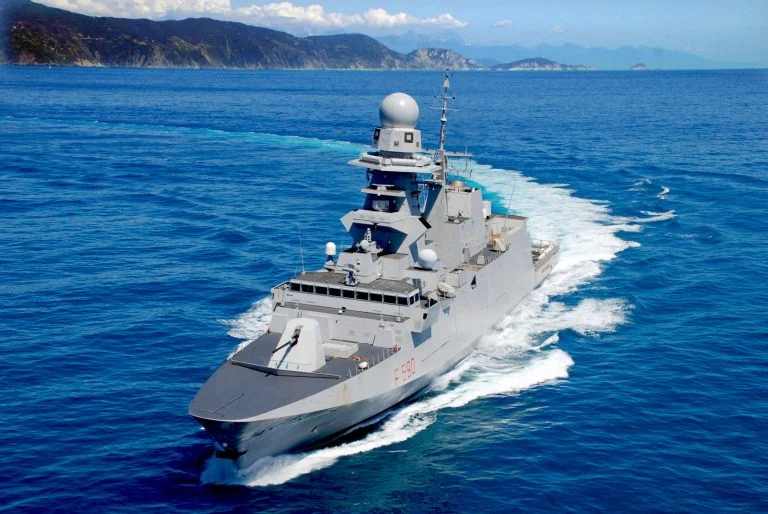
In line with New Delhi’s Aatmanirbhar Bharat framework to guarantee technology transfer and domestic production, India’s Coast Guard is advancing negotiations with Italy’s Fincantieri to jointly develop next-generation maritime and counter-drone technologies.
In order to safeguard its huge Indian Ocean theater, India prioritizes drone defense and sophisticated shipbuilding capabilities, as demonstrated by this encounteThe state-run shipyard Fincantieri in Italy is offering cutting-edge marine and counter-drone equipment to India’s quickly modernizing Coast Guard.
The talks take place at a time when maritime security issues are becoming more pressing and New Delhi is stepping up efforts to overcome capability gaps throughout its vast Indian Ocean operations theater.
The Director General of the Indian Coast Guard, Paramesh Sivamani, met with senior Fincantieri executives, led by Eugenio Santagata, Head of the Military Naval Vessel Division, at Coast Guard Headquarters in New Delhi, according to the Ministry of Defense.
rThe strategic importance both governments place on strengthening defense-industrial ties was highlighted by the inclusion of Anna Ruffino, Head of the Economics and Innovation Department at Italy’s Embassy in India, in the Italian delegation.
The agenda included anti-drone defense and counter-unmanned aerial systems. Following the extensive use of unmanned aerial systems on the battlefield in recent conflicts, there has been a global doctrinal shift in maritime security.
Drone defense has been highlighted as a key capability requirement by India’s Coast Guard, which is responsible for regulating one of the most strategically disputed coastlines in the world.
Higher sea state hull designs, improved bollard pull, hybrid and electric propulsion systems, and modular platform configurations that allow for quick operational role switching were all discussed in shipbuilding.
.
These characteristics are essential for the Coast Guard’s various duties, which include disaster relief, humanitarian aid, anti-smuggling operations, and coastal surveillance.
Co-development of sophisticated thrusters, dynamic positioning systems, and artificial intelligence-enabled decision support tools were also discussed. Fincantieri has strong proprietary experience in these areas, and integrating them would greatly improve operational resilience and efficiency in challenging maritime settings.
The interaction was framed by both parties within the framework of India’s Aatmanirbhar Bharat self-reliance. This indicates that any eventual agreement would put domestic manufacturing and technology transfer ahead of simple purchase, guaranteeing that India’s industrial base will directly profit from the partnership.
At a time when defense spending are rising dramatically throughout the region, Fincantieri can get access to one of Asia’s most active naval expansion programs by expanding its presence in India.
Through its subsidiary WASS, which provides heavyweight torpedoes to the Indian Navy, the corporation has already established a presence in India. Its position in India’s marine modernization would be strengthened by increasing collaboration with the Coast GuardIn line with India’s aspirations for maritime security, the exchange provided a foundation for future collaboration in shipbuilding, maritimIt demonstrated how India’s desire to develop domestic capability and Italy’s proficiency in cutting-edge naval systems could coexist, paving the basis for long-term cooperation.
e technology, and capability development.
.