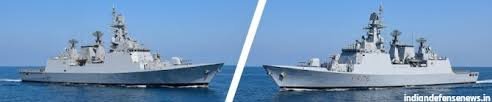
With the introduction of cutting-edge stealth warships that expand its operational capabilities, the Indian Navy is seeing a major fleet expansion. The commissioning of INS Taragiri and the recent deliveries of INS Mahendragiri and INS Dunagiri demonstrate a clear move toward multirole readiness, blue-water operations, and a persistent presence throughout the Indian Ocean.
According to an Indian report These advancements are currently a part of Project 17A, an initiative to build seven Nilgiri-class stealth frigates to replace the Shivalik-class, India’s first stealth warships built domestically.
China and Pakistan are increasing their maritime capabilities in the area at the same time as these warships are being inducted. In response, India has accelerated its naval modernization, making sure that its fleet is prepared to deal with attacks from the air, the sea, and the surfaceAfter INS Dunagiri arrived at Garden Reach Shipbuilders and Engineers Ltd (GRSE) in Kolkata on March 30, INS Mahendragiri was delivered on April 30 at Mazagon Dock Shipbuilders Limited (MDSL) in Mumbai. The Navy’s multirole capabilities were further strengthened with the commissioning of INS Taragiri earlier in April.
.The three ships are guided-missile battleships with sophisticated stealth characteristics that make them less noticeable to enemy radars and sensors. The commissioning of INS Aridhaman, India’s third nuclear-powered ballistic missile submarine, at the same time as their induction highlighted the Navy’s quick development on both surface and underwater platforms.
The sixth ship in the Nilgiri class, INS Mahendragiri (Yard 12654), is the fourth vessel constructed by MDSL. Project 17A has over 75% indigenous content, demonstrating India’s increasing capacity to design and build advanced warships at home.
The Warship Overseeing Team in Mumbai oversaw the design, which was headed by the Indian Navy’s Warship Design Bureau. Over 200 micro, small, and medium-sized businesses (MSMEs) have been involved in the project, creating over 10,000 indirect jobs and about 4,000 direct jobs.The second ship constructed at GRSE in Kolkata, INS Dunagiri, Yard 3023, is the fifth Nilgiri-class vessel. The INS Dunagiri, a British-built Leander-class frigate that served the Navy for 33 years till 2010, is revived.
The new Dunagiri is outfitted with torpedoes for anti-submarine warfare, a 76 mm super fast gun mount, MFSTAR radar, Barak-8 medium-range surface-to-air missiles for air defense, and BrahMos supersonic missiles for anti-ship and land-attack tasks. To increase its operating reach, it can also board two helicopters, like the Sea King or HAL Dhruv.
With its higher displacement of roughly 6,670 tons, sophisticated weapon-sensor suites, and modular construction methods, Project-17A frigates represent a generational advance over the Shivalik-class.
They are equipped with Combined Diesel or Gas (CODOG) propulsion plants, which enable high-speed maneuvers with gas turbines and effective cruising with diesel engines. By automating machinery control, tBy employing composite materials, radar-absorbent coatings, flush-mounted armaments, and enclosed mooring decks, stealth capabilities are attained through decreased radar cross-section. Advanced exhaust systems reduce infrared traces, and carefully made propellers that postpone cavitation guarantee acoustic stealth.
he Integrated Platform Management System (IPMS) lessens crew labor and improves dependabilGiven rumors of Chinese patrol boats in the Indian Ocean, these characteristics make the ships more difficult to find and target.Pakistan-India Relations
These warships’ sturdy design and better damage control systems increase their survivability. Because of their adaptability, they can support blue-water missions including power projection and sea-lane defense while carrying out anti-surface, anti-air, and anti-submarine operations.
ityThe Navy’s capacity to operate far from its home coast across deep oceans for extended periods of time is known as “blue-water capability,” and it is a characteristic of significant maritime powers.
The induction of INS Mahendragiri, INS Dunagiri, and INS Taragiri under Project 17A collectively demonstrates India’s resolve to safeguard the Indian Ocean Region and its dedication to self-reliance in defense manufacture. India is getting ready for a more competitive maritime environment with more than 100 domestic warships now making up the majority of its fleet.
For many years to come, these multi-role stealth platforms—which may operate independently or integrate into task forces—will be essential to protecting India’s seas.
.