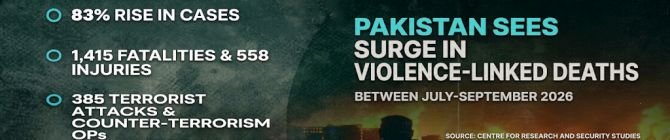
According to a WION article, Pakistan has become the world’s most terrorism-affected country for the first time in history, according to the Institute for Economics & Peace’s Global Terrorism Index 2026.
According to the Sydney-based research tank’s annual report, Pakistan experienced 1,139 deaths from 1,045 terrorist events in 2025, up nearly 6% from 2024.
According to the report, Pakistan registered 1,139 terrorism-related fatalities and 1,045 occurrences in 2025, an almost 6% rise over the previous year’s total.
Persistent counter-terror operations and cross-border militant activity along the Afghanistan-Pakistan borderlands drove the increase in fatalities, making Pakistan the primary global focus of militant impact, surpassing Burkina Faso.
This dismal milestone marks Pakistan’s bloodiest year from terrorism since 2013, and it continues an unbroken six-year record of growing bloodshed. Until now, Burkina Faso had the terrible distinction of leading the index, but Pakistan’s deteriorating security situation has caused it to overtake the West African nation by 2025.
The research identified two key factors for the surge: the Taliban’s 2021 takeover of Afghanistan, which created new opportunities for cross-border militant movements, and the Tehrik-i-Taliban Pakistan’s increased operations alongside the Balochistan Liberation Army. The TTP, in particular, has been identified as not only Pakistan’s most lethal rebel group, but also the third-deadliest terrorist organization in the world.
Geographically, the violence has been focused in Balochistan and Khyber Pakhtunkhwa, which have historically been hotspots for separatist and Islamist insurgent activity. Aside from the death toll, the human cost in 2025 includes 1,595 wounded and 655 hostages taken during attacks.
The Global Terrorism Index, now in its thirteenth edition, evaluates 163 countries representing 99.7% of mankind using a composite score that includes deaths, injuries, hostages, and property loss. Despite a ten-year reduction in terrorism-related deaths, Pakistan’s trajectory contradicts this positive global trend.
Former Pakistani ambassador Husain Haqqani responded to the results, saying that decades of cultivating militant proxies had now come back to haunt Islamabad, comparing the situation to raising snakes in one’s own backyard.