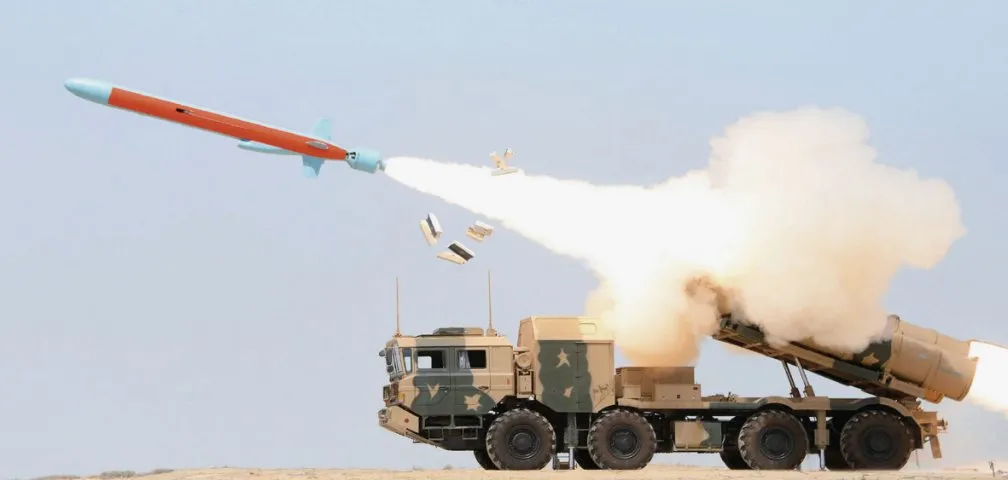
Islamabad’s increasing focus on missile-based deterrence and long-range precision strike capabilities is demonstrated by Pakistan’s most recent test of an extended-range Fatah-4 ground-launched cruise missile.
Prime Minister Shehbaz Sharif, President Asif Ali Zardari, and Field Marshal Asim Munir all praised the launch on October 6. Official statements highlighted enhanced avionics, navigation systems, accuracy, and survivability. Although no official measurement has been provided, reports indicate that the missile’s range may now surpass the previously reported 750 kilometers.
The test is indicative of a more general change in Pakistan’s military philosophy. Pakistan’s military posture has shifted to rely more on conventional missile forces and precision-strike systems since the Army Rocket Force Command was established in 2025.
This strategy is similar to advancements in China’s People’s Liberation Army Rocket Force, which maintains substantial stockpiles of precision-guided ballistic and cruise missiles to offset other military constraints and offer traditional strategic deterrence.
The Fatah-4, which is intended for terrain-following flight at extremely low altitudes, is a member of Pakistan’s growing Fatah missile family.
The missile is intended to fly at altitudes as low as about 50 meters while maintaining high levels of accuracy against ground targets, according to publicly published specs.
Such weapons’ capacity to take advantage of gaps in radar coverage, rather than their speed, is a dilemma for India.
On the other hand, India has spent years developing capabilities intended to counter these threats.
The NETRA airborne early warning and control aircraft of the Indian Air Force were designed to identify low-flying objects that might elude traditional base radars.
India’s defense strategy includes more than just detection.
These layers include the Indo-Israeli MR-SAM network, the Russian-made S-400 system for long-range interception, and native Akash air defense systems that operate at lower ranges.
The Akashteer command-and-control network, which connects sensors and shooters around the battlefield to facilitate quick target assignment and engagement, is progressively supporting the entire architecture.
Additionally, India is developing its own long-range air defense capabilities.
Offensive capability is also seen by planners as a crucial element of deterrence.
In addition to BrahMos, India is developing long-range land-attack cruise missiles and introducing the Pralay tactical missile to offer a wider variety of conventional strike options.
Despite their adaptability, mobile missile launchers are nevertheless susceptible once they are detected.
Scaling production is another issue Pakistan must deal with.
Missile-intensive conflicts have the potential to quickly deplete stockpiles, putting a heavy burden on state budgets and defense-industrial capacity.
With programs like the Army Rocket Force Command and the Fatah-4, Pakistan is obviously making investments in that future battlefield.
Therefore, the Fatah-4 is a capability that warrants careful observation, but it does not significantly tip the military balance in the area.