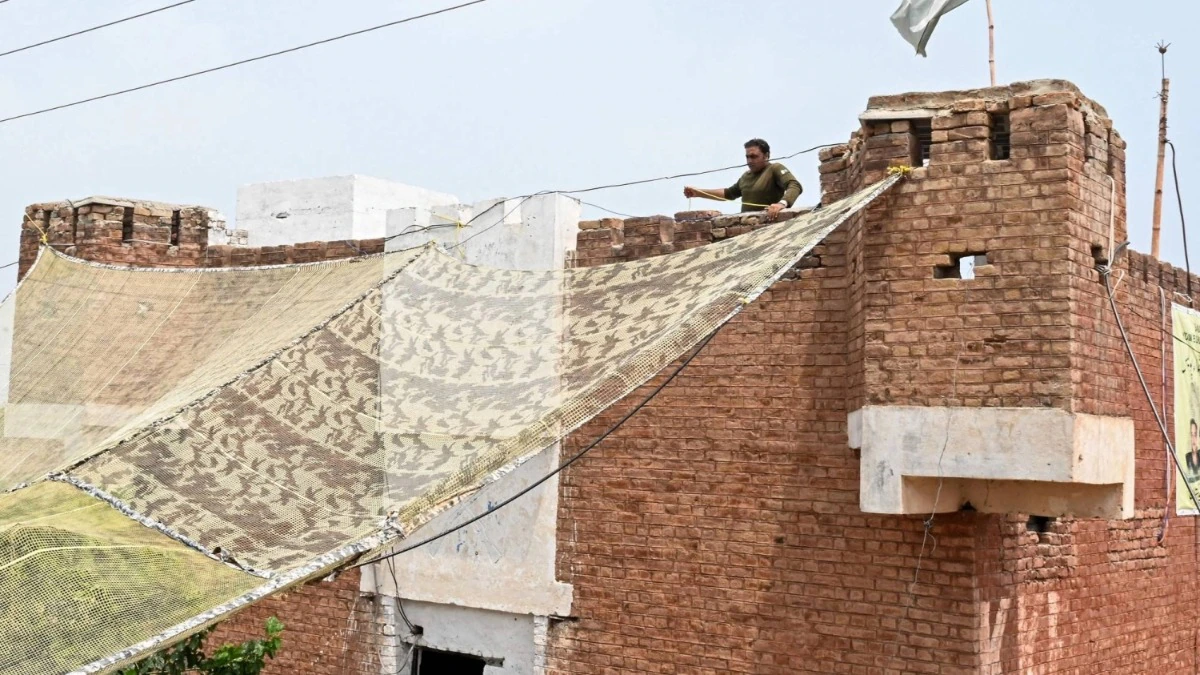
Pakistan has used fishing nets suspended over security outposts and checkpoints to defend military and police positions near the Afghanistan border in response to an increasing number of drone attacks along its western border, according to India Today.
Security forces are finding it challenging to counter the increasingly sophisticated drone campaign being waged by the Tehreek-e-Taliban Pakistan (TTP), also known as the Pakistani Taliban.
Tensions between Pakistan and Afghanistan have increased along with the security threat. Islamabad continues to accuse Kabul of giving asylum to TTP militants, a claim Afghanistan denies.
One security guard was killed and numerous others were injured in the attack, underscoring the growing threat presented by commercially available drones that have been adapted for conflict.
While specialized anti-drone systems can cost anywhere from ₹4.65 lakh to over ₹46 crore, depending on capabilities and sophistication, covering a typical guard station with netting costs about ₹1.30 lakh.
In other war zones, such as Ukraine, where forces have experimented with physical barriers to counter low-flying drones and loitering weapons, variations of overhead mesh protection have emerged.
Because militant groups can divert attacks from heavily guarded checkpoints to other susceptible sites, some analysts contend that the nets run the risk of fostering a false sense of security.
Pakistan presently uses a combination of Turkish and Chinese counter-drone systems, but since vulnerabilities were revealed during Operation Sindoor last year, doubts about their efficacy have grown.
Islamabad has apparently looked at other anti-drone technology from foreign suppliers, such as the US-based company Powerus, in an effort to bolster its capabilities.
The group mostly uses low-cost commercial quadcopters that can be altered for explosive attacks, surveillance, and reconnaissance.
According to Pakistan, in the first half of 2026, it stopped 341 drone assaults in Khyber Pakhtunkhwa.
The numbers highlight how quickly drones have become as a key component of insurgent combat in the northwest of Pakistan.
Their deployment highlights the mounting pressure on Pakistan’s security forces as they adjust to a battlefield increasingly influenced by inexpensive, easily accessible, and hard-to-detect unmanned aircraft, regardless of whether they end up being functional or just symbolic.