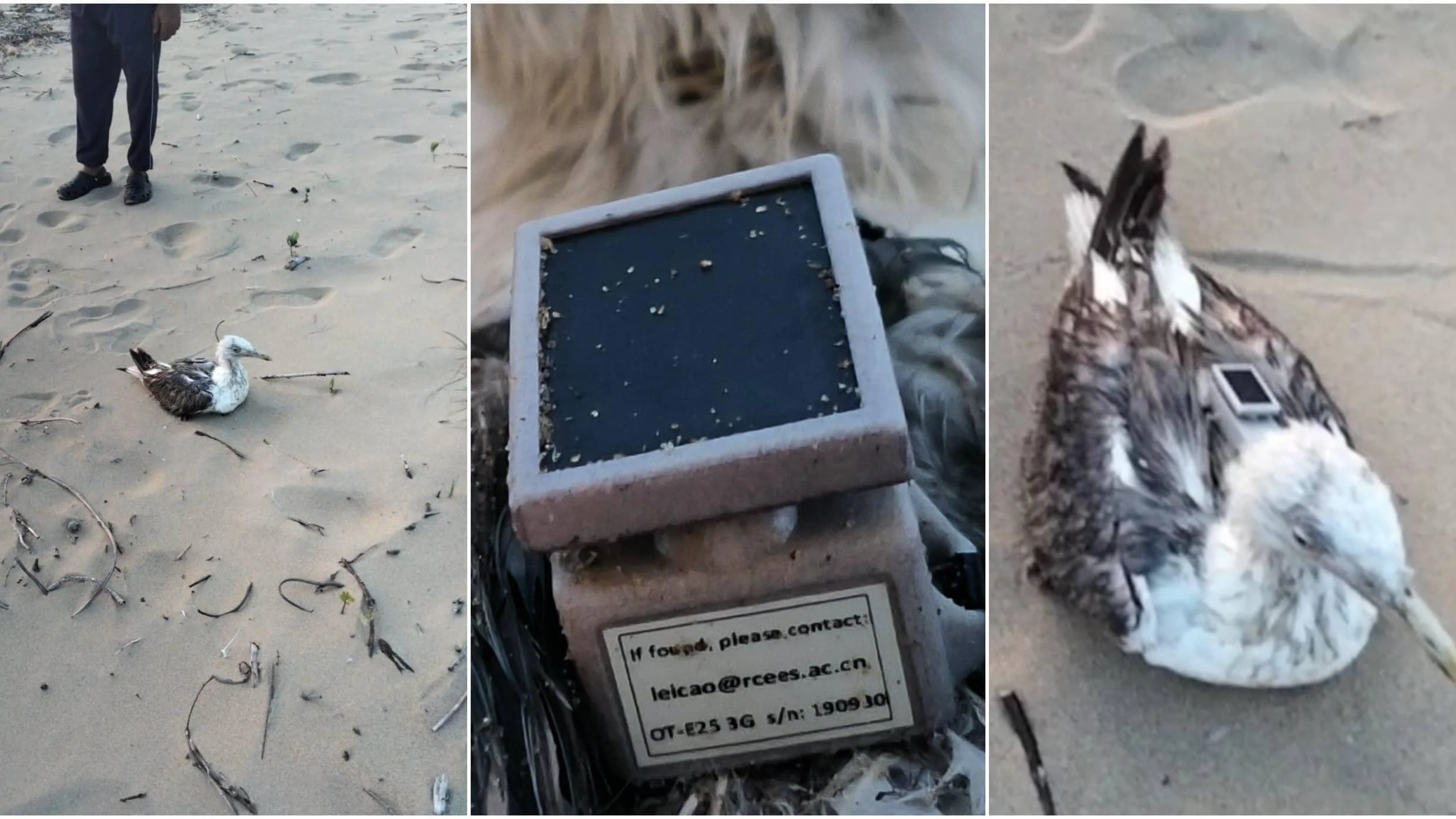
A seagull carrying a GPS monitoring device made in China was found close to the strategically important INS Kadamba naval installation in Karnataka’s Uttara Kannada state, raising immediate security concerns.
Personnel from the Coastal Marine Police Cell saw the bird on Tuesday, and it was sent to the nearby forest department wing for more analysis. This incident, which occurs close to one of India’s most sensitive maritime installations, has prompted a multi-agency investigation amid increased coastal vigilance.
A key component of the Indian Navy’s operational infrastructure, INS Kadamba is home to a number of valuable assets, such as the aircraft carriers INS Vikramaditya and INS Vikrant, as well as cutting-edge submarines and other warships. The base’s crucial role in national defense, especially in fending off regional maritime threats from players like China and Pakistan, is highlighted by its location in the Arabian Sea region. In a time of growing Sino-Indian naval tensions, locals have voiced concern, seeing the tracked bird’s presence as a possible espionage vector.
The GPS tracker had markings connecting it to the Chinese Academy of Sciences, notably the Research Center for Eco-Environmental Sciences, according to preliminary checks by authorities. The purpose of the ornithological study instrument was to track the flight paths, eating habits, and movement patterns of migratory birds over international routes. An email address and the typical request, “If found, please contact,” were etched on the tracker, instructing finders to get in touch with the center to ensure the bird’s safe return.
Given China’s growing involvement in international animal tracking programs that sometimes cross crucial border areas, the revelation has raised concerns about dual-use technology. Although bird migration studies are valid, Indian defense analysts point out that the close vicinity to INS Kadamba—just a few kilometers from the find site—raises concerns about accidental or intentional information collecting. In the backdrop of India’s “Atmanirbhar Bharat” quest for domestic surveillance capabilities, historical precedents—such as foreign drones spotted close to military locations—amplify these worries.
The Coastal Marine Cell of the Forest Department is in charge of the investigation into the tracker’s origins, according to Uttara Kannada Superintendent of Police Deepan MN. He said, “The matter is under investigation from multiple angles,” highlighting careful cross-checks to rule out foul play. The gadget is currently undergoing forensic analysis, which includes looking for data transmission records that could show real-time tracking to Chinese servers.
This incident is consistent with larger trends of alertness along India’s 7,500-kilometer coastline, where the Coast Guard and Navy use sonar, radar, and AI-powered sensors to identify irregularities. Lessons learned from previous invasions, including the 2021 Chinese research vessel sightings near Lakshadweep, are reflected in recent modifications at INS Kadamba, including improved anti-drone equipment and cyber defenses. Although the Indian Navy has not yet released an official statement, sources suggest that it is working in tandem with intelligence organizations such as the Intelligence Bureau and NTRO.
Seagulls and other migratory birds frequently travel the India-China migratory corridor, which runs from the Tibetan Plateau to the Indian Ocean, environmental experts warn. Since the program’s inception in the middle of the 2010s, thousands of birds have been tagged for ecological data, and the results have been published in journals such as Bird Conservation International. However, the failure to notify Indian authorities in advance of tags entering sensitive areas creates political undercurrents and may lead to talks through the India-China border management channels.
In accordance with procedures outlined in the Wildlife Protection Act of 1972, authorities have asked the public to report similar sightings without interfering with devices while the investigation progresses. Uttara Kannada is now the subject of increased surveillance by forest rangers and marine police. In order to prevent future alarms, bilateral agreements on transboundary research may be necessary if the tracker’s veracity is verified.
This event draws attention to weaknesses in hybrid fields where military security and civilian research collide in the larger geopolitical context. India’s defense establishment is probably going to examine avian surveillance countermeasures based on its experiences with DRDO’s domestic monitoring technology and HAL’s aerospace integrations. Whether this turns out to be a harmless research error or a trigger for more coastal regulations will become clear in the coming days.