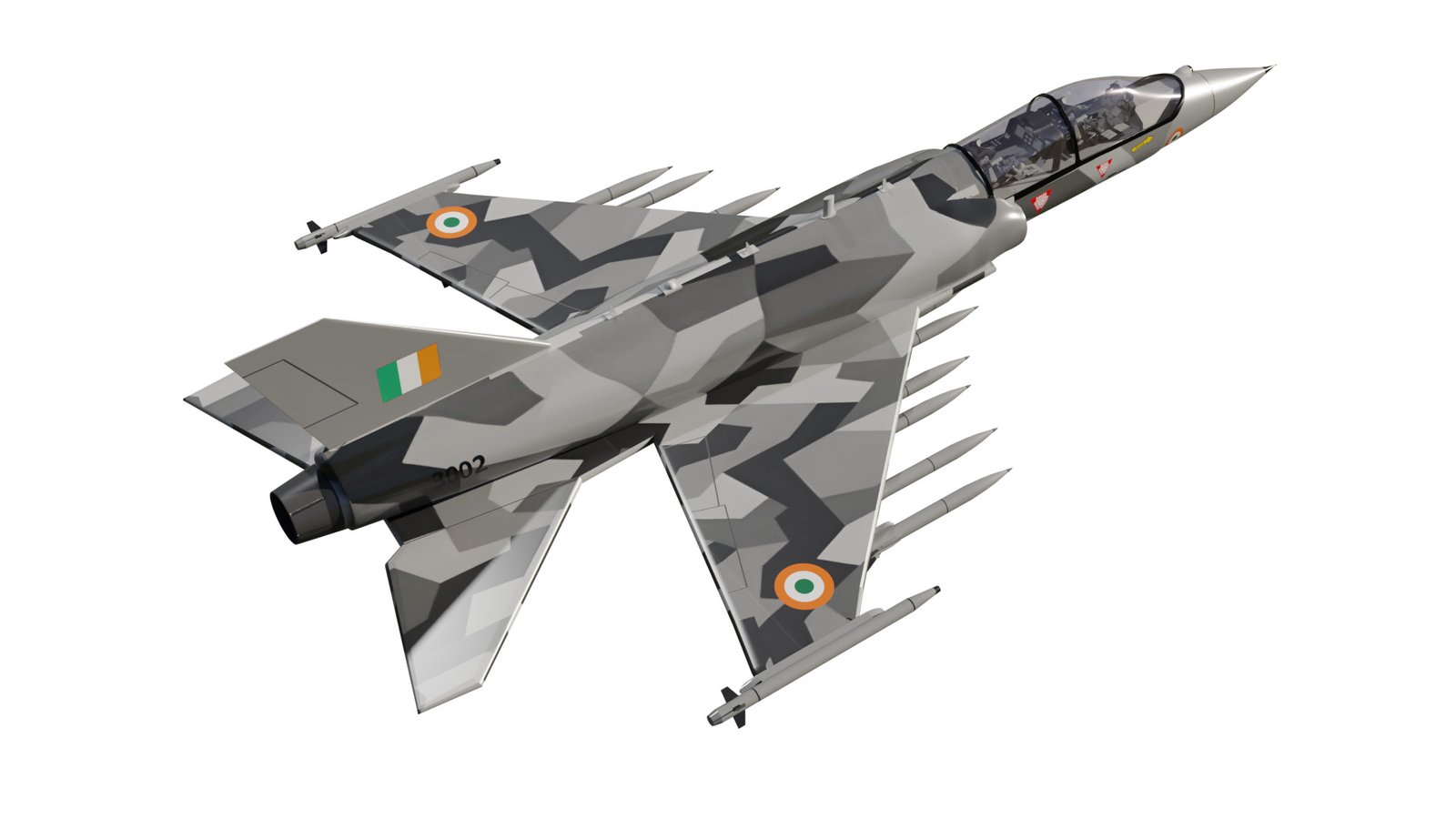
Expert pilots play a crucial role in the Indian Air Force’s fearsome strength, which is acknowledged by the globe. To improve their abilities, these pilots go through intense training, which includes flights in cutting-edge trainer aircraft. According to Zee News, Hindustan Aeronautics Limited (HAL) has demonstrated success in this area by creating the Hindustan Lead-in Fighter Trainer, or HLFT-42.
This enormous initiative gives IAF pilots the tools they need to become proficient in contemporary fighters like the Sukhoi Su-30MKI, Rafale, and TEJAS versions. The HLFT-42’s air-intake system, which directs air to the engine, has undergone major design improvements, according to recent reports.
The air inlet has been significantly moved to the underside of the wings in the most recent layout. This modification improves training relevance by closely aligning the HLFT-42’s configuration with India’s upcoming TEJAS MK-2.information on India’s defense
The revamp goes beyond simple visual adjustments. By placing the intakes beneath the wings, the engine’s airflow efficiency is increased, increasing speed, maneuverability, and overall performance.
A comparable sophisticated system, known as a “Y-shaped” duct architecture, is used by the TEJAS MK-2. This resemblance guarantees that throughout training, pilots will become practically acquainted with next-generation aerodynamics.
IAF pilots are more equipped to meet the demands of fifth-generation warfare, where precision engine control and supersonic stability are essential.
Because they allow the engine to “breathe” efficiently, air intakes are essential to fighter design. Airflow distortion brought on by poor intake geometry increases the danger of engine surges or stalls, particularly at high speeds.
These problems are lessened by the improved underside intakes of the HLFT-42. They reduce turbulence and improve stability during forceful maneuvers by maintaining laminar airflow even above Mach 1.
Inspired by successful low-observable, high-performance jets, this configuration maximizes thrust vectoring while minimizing radar cross-section.
For a long time, India required a link between basic trainers like the Hawk Mk 132 and combatants. This gap is filled by the HLFT-42, which replicates actual combat situations without the expense of twin-engine monsters.
In order to facilitate a smooth transfer to platforms such as the Advanced Medium Combat Aircraft (AMCA) or TEJAS MK-2, pilots will receive training on domestic radars, electronic warfare suites, and missile interfaces.
Under the Atmanirbhar Bharat concept, the HLFT-42 prioritizes self-reliance with avionics designed by HAL. Instructors can keep an eye on it and take immediate action thanks to its dual cockpit.
The aircraft, which is probably powered by a variant of the GE F404 engine, which is well-known from TEJAS, promises twin-engine redundancy in an affordable package. With a service ceiling of more than 12 km, estimated top speeds surpass 1,000 km/h.
Compared to sorties on Rafales or Su-30s, which cost lakhs per hour, training expenditures are extremely low. The HLFT-42 could reduce costs by 60–70%, allowing aspiring pilots to fly more.
Lessons from the TEJAS program are reflected in HAL’s iterative design approach. The intake shift was validated by wind-tunnel experiments and CFD simulations, which confirmed greater pressure recovery under off-design circumstances.
The HLFT-42 is now positioned as a key component of IAF modernization thanks to its advancement. A dedicated lead-in trainer guarantees pilot competency in the face of growing threats from China and Pakistan, with 14 squadrons of TEJAS MK-2 scheduled by 2035.
Induction is planned for 2030, with prototypes expected to be released by late 2027. The HLFT-42 is crucial to India’s aspirations for the fifth generation. Pilots are prepared for covert, network-focused missions with its avionics backbone, which may have Uttam AESA radar.
This trainer strengthens IAF readiness in an area where there are tensions on two fronts. Pilots that have mastered the dynamics of the HLFT-42 will be able to switch to AMCA with ease, using hypersonic weapons and AI-driven sensors.
These developments are highlighted by Zee News, highlighting HAL’s shift toward export potential. Countries interested in TEJAS may combine it with HLFT-42 for comprehensive prototype pipes.
In the end, the HLFT-42 represents India’s rise in the aerospace industry. It changes training from simulation to simulation of superiority by replicating TEJAS MK-2 realism.information on India’s defense