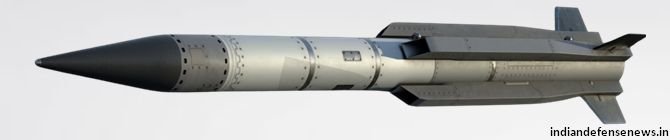
According to sources from May 2025, the DRDO’s STAR (Supersonic TARget) missile development has advanced into Phase-III, marking a significant milestone.
The complex integration of propulsion, guidance, and control systems into finished prototypes is the main focus of this phase. Critical hardware components, including as motor casings, nozzles, and related subsystems, have already been manufactured by teams at DRDO’s facilities.
In order to guarantee the missile’s dependability in combat simulations, advanced validation experiments are presently being conducted. The start of combat-style flight trials indicates an impending operational deployment. These tests validate the missile’s performance at different altitudes and speeds by simulating real-world situations.
The STAR program, which was first designed as a supersonic target drone for testing and training India’s air defense systems, is currently investigating combat uses. A suggested “anti-AWACS” variation is still being tested, demonstrating DRDO’s desire to use it for purposes other than target simulation. This development is consistent with India’s Make in India campaign, which promotes multi-role indigenous systems.
DRDO is exploring two main STAR missile types to meet various operational needs. The air-launched variant is intended to be integrated into fighter aircraft like the LCA Tejas. It is crucial for drills like Operation Sindoor because it replicates high-threat air-to-air and air-to-ground engagements, such as anti-radiation and anti-AWACS missions.
By simulating enemy tactics, including as electronic warfare jamming and aerial surveillance threats, this air-launched STAR improves joint-force training. It provides realistic threat reproduction at supersonic speeds greater than Mach 2 and can be carried externally or semi-recessed aboard Tejas fighters. Pilot preparedness against sophisticated airborne early warning systems is strengthened by such skills.
The ground-launched STAR variant, designed for truck-mounted, mobility deployment, complements this. This configuration can be quickly set up from shorelines, distant forward bases, or contested zones because it doesn’t require any fixed infrastructure. It is especially useful for Indian Army and Navy exercises that mimic inland interception and coastal defense situations.
The mobility of the ground-launched device solves important logistical issues in India’s varied topography, from island areas to Himalayan frontiers. It supports large-scale exercises without requiring expensive airfields or static launchers because it may be launched from modified tactical vehicles. Its potential to transform low-cost, high-fidelity target practice is highlighted by defense analysts.
The design of STAR makes it suitable for tactical weaponization in addition to its training function. Experts predict that it may successfully target enemy radars and observation planes with little changes, such improved warheads and seeker upgrades. By assessing seeker technology for locking onto airborne emitters, this “anti-AWACS” proposal presents STAR as an affordable substitute for more expensive missiles.
By offering reasonably priced suppression of enemy air defenses (SEAD) capabilities, such a combat variant would close a significant gap in India’s arsenal. A weaponized STAR could improve IAF operational freedom by neutralizing AWACS platforms at standoff ranges when combined with systems like the Akash-NG or QRSAM. DRDO’s assessment is based on successful examples such as the Israeli Harop loitering munition.
A solid-fuel rocket motor that provides continuous supersonic flight continues to be a key component of STAR’s development. Phase-III improves maneuverability during terminal phases by integrating cutting-edge thrust vectoring nozzles. With choices for data lines to simulate jammed conditions, guidance uses inertial navigation enhanced by GPS/INS.
Fly-by-wire actuators in control systems provide accurate trajectory control, which is crucial for avoiding interceptors during trials. To validate air-launch dynamics, these subsystems have completed captive carriage tests and static firings on Su-30MKI platforms. Ground tests verify a range of more than 150 km and endurance of up to 10 minutes at Mach 2+.
In order to save weight, motor casings are manufactured using modern composites, utilizing DRDO’s domestic supply chain. While subsystems like telemetry pods guarantee real-time data during flights, nozzles use ablative materials to survive high thermal stresses. This independence reduces dependency on imports, which is consistent with the objectives of Atmanirbhar Bharat.
Phase-III flight testing mimic salvo launches and networked operations and are carried out from the Integrated Test Range in Chandipur. Iterations are accelerated by feeding data from these tests into digital twins for predictive modeling. If all goes well, STAR might be inducted by 2027, first for the IAF and IN.
Defense analysts are excited about the program’s dual-use potential and see STAR as a bridge to next-generation hypersonic targets. Developing it into a tactical missile might improve India’s defense diplomacy by exporting it to friendly countries. Partnerships between Russia and India on seeker technology could improve its anti-radiation accuracy even more.
There are still issues, such as warhead integration without sacrificing aerodynamics and seeker miniaturization for AWACS homing. Environmental testing in high-G and EMI environments is still crucial. However, DRDO’s experience with systems like the Rudram missile gives optimism that these obstacles can be overcome.
The Phase-III development of STAR highlights DRDO’s growing proficiency in supersonic systems. It demonstrates strategic insight in the face of growing regional threats from China and Pakistan, ranging from training assistance to possible game-changer. India’s defenses will be strengthened by operationalization, guaranteeing superiority in disputed airspace.