According to reports, China has started spreading false information about India’s Great Nicobar Port project, painting it as both politically divisive and environmentally damaging.
According to analysts, this is a component of Beijing’s larger plan to weaken India’s strategic position close to the Strait of Malacca, which is a vital chokepoint for Chinese oil and tradeThe Great Nicobar Island Development Project, designed by NITI Aayog and approved by the Union Cabinet in 2021, is estimated to be about ₹81,000 crore (almost $10 billion). Great Nicobar is intended to become a significant commercial and strategic center.
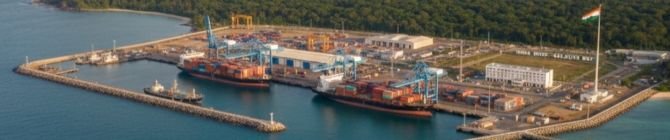
The focal point is a transhipment port in Galathea Bay, which is situated on an 18–20 meter naturally deep harbor. By 2028, the port is anticipated to handle 4 million TEUs, and by 2058, it would grow to 16 million TEUs, matching Singapore’s capacity and establishing India as a major Indo-Pacific maritime power.
A 450 MW solar and gas power plant, an international greenfield airport with a 3,300-meter runway that can handle wide-body aircraft, and the development of the Andaman and Nicobar tri-service command into a frontline strategic arm are all included in the project.
By serving both military and civilian functions, these facilities would improve India’s capacity to project power and protect its marine interests.
.The project’s location is the reason for China’s resistance. One of the primary passages into and out of the Strait of Malacca, the Six Degree Channel, has Great Nicobar at its mouth. Two-thirds of China’s total trade and more than 80% of its oil imports, worth roughly $312 billion a year, flow through this small river.
This weakness, which former President Hu Jintao memorably referred to as the “Malacca Dilemma” in 2003, has long been acknowledged by the Chinese leadership. China’s reliance on the strait is still severe, with over 15 million barrels of oil consumed per day and just 3.7 million delivered via overland pipelines.
According to reports, China has attempted to sabotage the project by escalating environmental concerns and fostering resistance among India’s political elite. There have been campaigns to restrict or stop the project’s progress that highlight ecological dangers and cast doubt on its profitability.