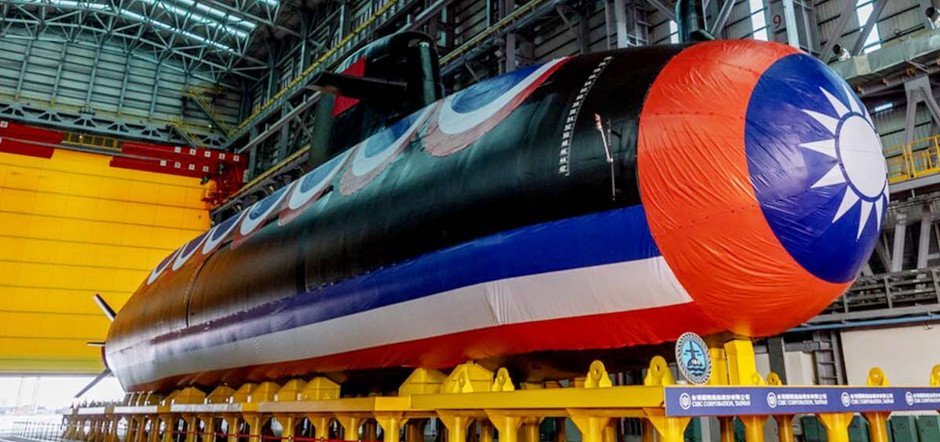
Taiwan has publicly recognized India’s contribution to its ambitious program for indigenous defense submarines of the Hai Kun class. With Taipei formally acknowledging New Delhi’s industrial and technical contributions, this is a pivotal time in regional defense cooperation.
Due to its strategic significance in the Indo-Pacific, the Hai Kun-class is Taiwan’s first attempt at producing a submarine that is both domestically developed and constructed. This project has garnered significant international attention.
According to a Global Taiwan report from February 2006, although India has not yet directly supported Taiwan’s submarine production program, there are chances for unofficial cooperation because of common issues with hull construction, subsystems, and sustainability. According to the report, Taiwan benefits from India’s experience renovating aging diesel-electric submarines such as the Kilo- and Type-209 classes, while India might profit from Taiwan’s lithium-ion battery technology for AIP systems. Given India’s non-recognition of Taiwan, such collaboration might take advantage of current commercial agreements (such as the Bilateral Investment Agreement 2018) without explicit defense arrangements.
However, India’s involvement has been comprehensive, going beyond the supply of specialized components to encompass structural elements and subsystem manufacture, as tact is crucial when handling the sensitivities surrounding China’s fixation with Taiwan. Taiwan has been able to overcome industrial constraints and maintain the integrity of its submarine building process thanks in large part to their contributions.
India has shown both its expanding industrial capacity and its readiness to assist partners confronting difficult security difficulties by supplying cutting-edge components designed to meet the exacting criteria of subsea platforms.
India has provided material support as well as advising skills through retired naval personnel who have a great deal of experience operating Kilo-class and Kalvari-class submarines. Their advice has been crucial in assisting Taiwan’s naval planners and engineers in incorporating tried-and-true operational procedures into the new domestic design.
The Hai Kun-class will be both technically sound and operationally successful thanks to this knowledge transfer, which has improved Taiwan’s capacity to incorporate cutting-edge equipment and improve its submarine doctrine.
Taiwan’s recognition highlights the significance of India’s growing role as an Asian defense technology partner. It emphasizes New Delhi’s ability to offer strategic advice support based on decades of operational experience in addition to producing and exporting essential components.
This partnership is part of a larger trend in which India is establishing itself as a dependable supplier of defense manufacturing and regional security.
A key component of Taiwan’s efforts to modernize its navy and improve deterrence in the face of escalating maritime concerns is the Hai Kun-class program. India’s backing has given the project more legitimacy and strengthened the idea that domestic defense projects may be successful with well-developed alliances.
In the Indo-Pacific, where defense cooperation is increasingly viewed as a counterbalance to regional power imbalances, the cooperation also represents New Delhi’s growing importance.
Taiwan has improved bilateral relations and conveyed the importance of economic and technical collaboration among like-minded partners by formally acknowledging India’s contributions. This development serves as an example of how mutual assistance and shared expertise can both advance strategic goals in a disputed maritime environment and expedite indigenous defense programs.