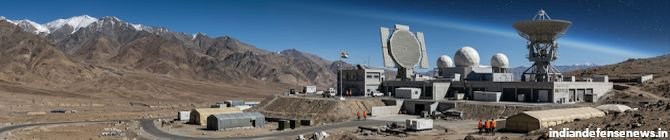
With plans to build an optical telescope at Hanle in Ladakh and a phased array radar in northeastern India, the Indian Space Research Organization (ISRO) is growing its network of facilities to watch space objects in Earth’s orbit.
At a time when Low Earth Orbit (LEO), which is between 500 and 1,000 kilometers above Earth, is becoming more crowded with satellites and debris, increasing the risk of unintentional collisions, these developments are part of a larger effort to improve India’s Space Situational Awareness (SSA) capabilities.
The Multi-Object Tracking Radar (MOTR) at the Satish Dhawan Space Centre in Sriharikota is now run by ISRO. This L-Band Active Phased Array Radar can track several objects at once.
It can track objects up to 1000 kilometers away with a radar cross section of 0.25 square meters. In order to maintain operational safety in orbit, the MOTR is essential for tracking Indian rocket bodies and satellites.
In 2025, a national-level expert group will have finished designing and reviewing the future radar in the Northeast, which is being produced domestically. In addition, the optical telescope at Hanle is being set up in Ladakh, a cold, high-altitude desert site selected for its pure skies and little air interference. Unlike radars, optical telescopes are only able to detect sunlight reflected off satellites and other space objects at night.
In partnership with ARIES, ISRO also showcased the renovation of the Baker Nunn Schmidt Telescope (BNST) at Nainital. This telescope will improve India’s capacity to track space objects once it is operational. When combined, these facilities will offer a complementing combination of optical and radar systems, which is necessary for all-encompassing SSAThe benefit of radars, which employ radio waves and their reflections to determine an object’s position, is that they may operate day or night. However, optical telescopes are only useful for identifying objects at greater altitudes and can only be used at night.
ISRO hopes to create a reliable network that can monitor satellites and debris at various orbital ranges by integrating these technologies across several sites.
To guarantee secure and long-lasting space operations, SSA tracks, monitors, and forecasts the locations of satellites and debris. To prevent accidents and evaluate the hazards to space assets, it needs data collected from telescopes and ground-based sensors.
.India’s increasing dedication to protecting its space infrastructure and supporting international efforts to manage orbital congestion is reflected in ISRO’s facility expansion.