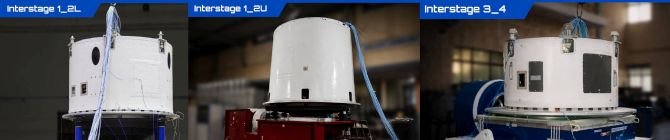
Vikram-1’s interstages are much more than just rocket stage couplings. Flight computers, navigation sensors, power systems, stage-separation mechanisms, and retro motors—all designed to function with extreme precision—are housed within their carbon composite constructions.
To ensure smooth transitions during ascent, these retro motors are timed to fire within milliseconds after stage separation events.
The Orbital Adjustment Module (OAM) is located at the very top of the vehicle. This module is in charge of the mission’s last and most exact task, which is to put each satellite into its correct orbit. Its function is crucial since the payload’s mission success depends on orbital precision.
These structures must endure severe vibrations in all directions while in flight. These are persistent waves at particular frequencies that continue during the ascent rather than haphazard shocks.Under such circumstances, any structural flaw or engineering error could result in failure, which is why thorough testing is essential.
The teams exposed the inter-stages and modules to the entire range of vibrations the rocket would experience during flight in order to guarantee reliability. The experiments were conducted on three separate axes at frequencies ranging from twenty hertz to two thousand hertz.
To replicate the challenging conditions of launch and ascension, each structure underwent numerous tests. Every structure passed these rigorous tests, proving their adaptability and durability.
The program has now progressed to Phase 3 checks once vibration testing is finished. All systems, including ground software, electrical interfaces, and full flight simulation, must be thoroughly validated at this phase.
Headline: Vikram-1 Passes Crucial Vibration and Systems Tests with Precision Under Pressure