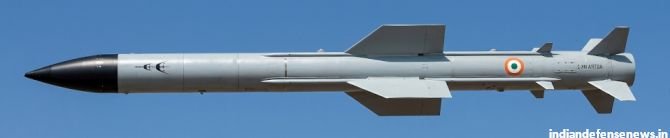
With its dual-pulse motor and indigenous seeker, the Astra MK-2 missile moves closer to user trials.
The Su-30MKI will be the first integration platform, followed by the TEJAS MK-1A, and production will make use of the baseline ASTRA infrastructure.
These tests marked a major advancement in the missile’s development by validating its propulsion system, guidance mechanisms, and aerodynamic design.
The ASTRA MK-2’s native active electronically scanned array (AESA) seeker is one of its main features. This seeker is better able to withstand jamming and electronic warfare techniques since it is outfitted with electronic counter-countermeasures (ECCM).
Additionally, the missile contains a dual-pulse solid rocket motor, which increases range and maneuverability by providing continuous push during various flight stages.
The two-way datalink that permits mid-course updates is another essential element. This ensures greater accuracy against maneuvering targets at longer ranges by enabling the missile to receive real-time guidance corrections from the launch
or other assets.
The missile program will now proceed to integrated user trials after completing preliminary trials. To verify performance in actual combat scenarios, these will entail operational testing with frontline squadrons. The production infrastructure currently set up for the baseline ASTRA system will be used to expedite induction once these trials are over.Database for weapon systems
The ASTRA MK-2 will be integrated into the Su-30MKI first, then the TEJAS MK-1A. India’s frontline fighters would gradually acquire improved long-range combat capabilities thanks to this phased induction plan, enhancing air dominance and deterrence posture.