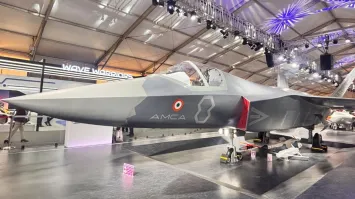
A state-of-the-art, domestic passive Infrared Search and Track (IRST) system designed for fifth-generation stealth operations will be integrated into India’s Advanced Medium Combat Aircraft (AMCA).
By avoiding any emissions that could reveal the aircraft’s location, this technology claims to identify low-observable targets at long ranges while maintaining the aircraft’s own stealth profile.
The dual-band capacity of the AMCA IRST, which operates over both the Mid-Wave Infrared (MWIR) and Long-Wave Infrared (LWIR) spectra, is one of its key features. This adaptability increases its efficacy against elusive enemies by allowing detection of both the more subdued “hardbody” heat signatures released by stealth aircraft and the hot exhaust plumes from engines.
The IRST is a completely passive detection technique that enables the AMCA to keep an eye on incoming missiles and aerial targets without sending out any signals. This characteristic makes it an essential countermeasure in stealth-focused warfare, as radar emissions may otherwise jeopardize the platform’s capacity to survive.
Often referred to as an Electro-Optical Targeting technology (EOTS), the technology blends in perfectly with the aircraft’s nose cone. The AMCA’s stealth features are preserved during operations thanks to this design’s reduced Radar Cross Section (RCS).
According to recent sources, performance benchmarks show that the IRST is designed to detect fifth-generation fighters, such the F-35 or F-22, at tactically relevant ranges.
The “Make-II” subcategory of India’s defense procurement structure, which gives priority to domestic innovation, is how development is carried out under the direction of the Defence Research and Development Organization (DRDO).
Adoption of Gallium Nitride (GaN) chips, which are highly valued for their improved heat resistance and elevated performance metrics under challenging settings, is one example of technological advancements.
Additional developments include the study of conformal IRST domes, which may improve stealth characteristics and offer possible 360-degree coverage for thorough situational awareness.
For test beds like the Hawker 800, flight trials for the supplementary EOTS are scheduled, signifying a crucial stage in validation and improvement.
In the end, the IRST is crucial for the AMCA Mk1 and Mk2 models, enabling them to succeed in radar-denied conditions that are common during fierce electronic warfare situations.
AMCA will integrate a cutting-edge, indigenous passive infrared search and track (IRST) system that defies stealth.