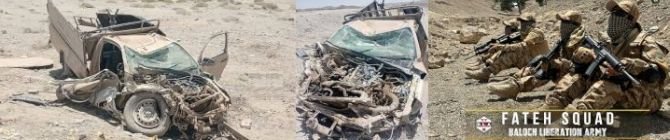
At least three Pakistani soldiers were killed in Panjgur, Balochistan, after their vehicle was struck by an improvised explosive device (IED). The attack highlights the continuing rebel violence in the province, where rebel groups have intensified operations against security forces.
Although the police have not yet disclosed official numbers, several more people were reportedly hurt. The attack highlights how vulnerable security troops are in isolated parts of Balochistan, where rebels regularly use ambush and roadside bombs.
This assault was a component of a larger uptick in insurgent activities throughout Balochistan. In Pasni, Gwadar district, a security forces vehicle was hit by another IED bomb that same day, resulting in additional injuries.
The incident occurred in Panjgur district, where a military convoy was targeted by an IED blast. According to local sources, the explosion destroyed the vehicle and resulted in the deaths of at least thThe twin bombs point to a rebel group’s planned escalation with the goal of simultaneously destabilizing several regions. Although no group has yet to take responsibility, Baloch separatist groups like the Balochistan Liberation Army (BLA) and Balochistan Liberation Front (BLF) have frequently been blamed for similar occurrences in the past.
ree soldiersThe incident in Panjgur coincides with a long-running uprising in Balochistan, where separatist and nationalist organizations have long charged that the Pakistani government is exploiting the province’s natural resources while marginalizing its people. Military convoys, infrastructure projects, and installations connected to the China-Pakistan Economic Corridor (CPEC) have been increasingly targeted by these groups. Counter-rebel operations have been launched by security forces in response, but the cycle of bloodshed continues to take lives on both sides.
One of the most common techniques used by fighters in the area is the usage of IEDs. These devices are quite effective against military vehicles, hard to detect, and relatively simple to manufacture. These weapons, which have caused many losses among Pakistani personnel over the years, continue to represent a threat, as evidenced by the Panjgur attack. Rebels still use the rough terrain and open borders to launch attacks in spite of enhanced patrols and surveillanceThe number of security personnel murdered in Balochistan in recent months has increased with the deaths of the three troops. Since the beginning of 2026, the uprising has gotten more intense, with reports of organized attacks, suicide bombings, and ambushes in several regions. The violence has been denounced by international observers, and Pakistan’s government has promised to keep up its efforts to bring stability back to the province.
.Balochistan’s strategic significance is further highlighted by the Panjgur incident. Important infrastructure projects, such as Gwadar Port, which is essential to the CPEC, are located in the province. In addition to endangering Pakistan’s domestic security, rebel strikes on military convoys and infrastructure also jeopardize the country’s economic aspirations linked to regional connections.
Security personnel are carrying out clearance operations in Panjgur after the explosion, and the atmosphere is still tense. Although an official statement from the authorities has not yet been released, additional military action in the district is anticipated as a result of the attack. The human cost of the ongoing battle and the difficulties Pakistan has in safeguarding its unstable southwestern province are highlighted by the death of soldiers.
.