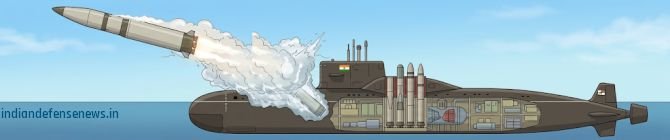
With the induction of the INS Aridhaman, also known as the S4 nuclear-powered ballistic missile submarine, India’s maritime nuclear deterrence is about to enter a significant new phase.
The geopolitical balance in Asia and beyond is drastically changed by this shift from regional attack capacity to intercontinental deterrence.
Currently equipped with the K-4 missile, which can hit targets up to 3,500 kilometers away, the submarine is being prepared for the next capability upgrade with the K-5 submarine-launched ballistic missile.
It is anticipated that full-range trials and initial “pop-up” launches of the K-5 missile will start in late 2026 or early 2027. The INS Aridhaman and the upcoming S4* submarine have undergone substantial physical changes to make room for this new class of weapon.
The S4 has a stretched 7,000-ton hull, in contrast to the previous INS Arihant and INS Arighaat, which had a displacement of about 6,000 tons and were limited by narrower hulls and launch bays. The depth and structural durability needed to accommodate the larger three-stage ballistic missiles meant for intercontinental flights are provided by this enlarged configuration.
Compared to its predecessor, the K-5 missile marks a significant technological advancement. The K-5 has a three-stage solid-fuelled system that increases its range to an estimated 5,000 to 6,000 kilometers, whereas the K-4 is a two-stage solid-fuelled missile intended for regional deterrence.
This puts it squarely in the category of intercontinental ballistic missiles, effectively acting as India’s land-based Agni-V’s sea-based equivalent. The missile still has a two-ton payload capacity, but Multiple Independently Targetable Re-entry Vehicles (MIRV) have revolutionized the nose cone.
MIRV technology is now being modified for maritime deployment after being successfully tested on land-based missiles under Mission Divyastra. This makes it possible for a single missile to carry four to six nuclear warheads, each of which can hit a different target.
The potential to overwhelm adversary missile defense systems with several warheads from a single launch, so ensuring a credible second-strike capability, is a strategically revolutionary capability.
These cutting-edge armaments are complemented by the increased architecture of the INS Aridhaman. The submarine provides previously unheard-of tactical flexibility by increasing the vertical launch system to eight huge missile tubes.
It can carry a combination of intermediate-range K-4s, long-range K-5s, and short-range K-15s with a range of 750 kilometers. This modular loadout ensures operational agility across a range of circumstances and enables the vessel to adjust to changing defense requirements without requiring significant structural refits.
Strategically, India’s deterrence stance is elevated to a worldwide level by outfitting the S4 with the K-5 missile. India’s nuclear triad, which was formerly limited to deterring threats within Asia, now spans continenThe credibility of India’s deterrent is increased and survivability is ensured by the capacity to launch intercontinental attacks while submerged in protected Indian Ocean patrol zones. From the INS Arihant’s proof-of-concept stage to the INS Aridhaman’s fully armed frontline combat platform, this development highlights the development of India’s sea-based nuclear capabilities.
tIndia’s undersea deterrent will be effective for decades thanks to the S4 class’s future-proofing to handle next-generation weapons like the K-5.
This development is also in line with India’s bigger strategic plan, which calls for the eventual deployment of the larger S5 class submarines, which are expected to weigh 13,500 tons, as well as the concurrent search for nuclear-powered attack submarines for long-duration missions.
When taken as a whole, these programs guarantee that India’s naval nuclear capabilities will keep developing in response to regional and international threats, ensuring a reliable deterrent position for many years to come.
s.