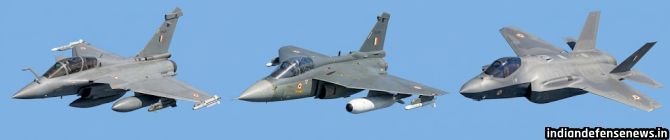
According to WION, the Indian Air Force is currently traversing a crucial strategic moment as it looks to modernize for upcoming aerial warfare challenges and replenish its diminishing combat fleet.
Air Chief Marshal AP Singh gave important insights into the service’s multi-tiered fleet development plans and current operational readiness to reporters in New Delhi prior to the 94th Indian Air Force Day celebrations.
The Air Chief emphasized that the Indian Air Force needs an annual induction rate of roughly 36 to 40 contemporary fighter aircraft over the next few years in order to close significant operational deficiencies.
The production schedules of the domestic Light Combat Aircraft TEJAS MK-1A program continue to be a major source of concern. Notable delays have been caused by global supply chain chokepoints, such as jet engine deliveries, as well as domestic system integration and radar calibration requirements.
Deliveries were supposed to start in March 2024 under the original agreement signed in February 2021, which was worth ₹48,000 crore for 83 aircraft. However, as of right now, no serial-production airframes have been put into active operational service.
The Air Force is closely monitoring the upcoming TEJAS MK-2 development program and potential acquisitions through the Multi-Role Fighter Aircraft project, which involves 114 combat jets with an estimated valuation of ₹3.25 Lakh Crore, in order to close these short-term capability gaps.
The Air Chief stated that the formal procurement contract for the Multi-Role Fighter Aircraft program might be completed during the current fiscal year provided talks between Indian and international sector parties go well.
In terms of fifth-generation stealth capabilities, the country is still dedicated to its domestic Advanced Medium Combat Aircraft program, which is run by industrial production partners and defense research institutions.
Air Chief Marshal AP Singh underlined, however, that in order to preserve complete air dominance, the Air Force may consider alternate international fighter platforms if unanticipated execution delays occur within the domestic fifth-generation stealth program.
Although the Air Chief acknowledged that no formal decision has been made regarding whether to assess or purchase this system, Russia has formally offered India its Su-57 stealth fighter platform.
The development of an indigenously produced fighter jet engine, which is being led by the DRDO’s Gas Turbine Research Establishment in Bangalore, is one of the most important strategic imperatives in addition to platform inductions: self-reliance in essential core technologies.
The Air Chief also discussed more general structural and technological changes, pointing out that although unified theater command models are being reevaluated in light of recent combat lessons, the integration of unmanned systems and artificial intelligence is still crucial.
In response to questions about unmanned platforms, the service explained that it plans to seamlessly integrate unmanned aircraft systems and loitering munitions directly into current combat wings for unified operational effect rather than establish a distinct specialized drone force.
