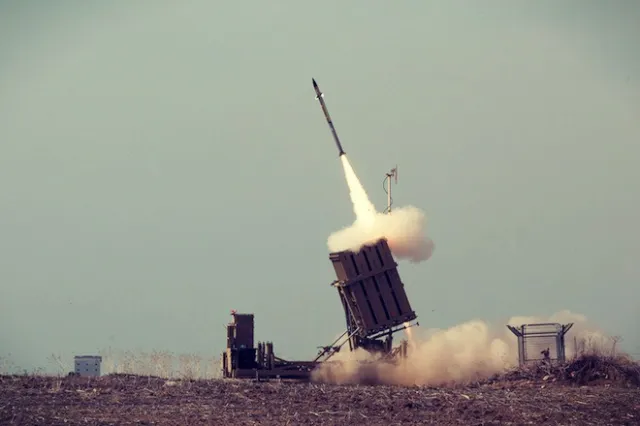
According to the Economic Times, IG Defense is getting ready to carry out the first experimental trial of JWALA, an indigenous private-sector micro-missile being developed as a specialized hard-kill counter-drone interceptor.
Following the successful test-firing of two solid rocket motors, a significant program development milestone, the system is anticipated to begin system-level testing in the upcoming months.
Prior to an experimental flight test, the integration of all key subsystems is made possible by the most recent propulsion experiments, which validate one of the most important aspects of the missile’s design. The majority of the missile’s essential parts, including as the warhead package, avionics, seeker and target-acquisition systems, and related electronic subsystems, have previously been created by the business.
JWALA is being developed as a small, reasonably priced kinetic interceptor that can physically kill adversarial drones. The missile is designed to meet the increasing need for reasonably priced counter-UAS solutions as drones continue to transform the economics of contemporary conflict.
The interceptor is expected to attack targets at ranges between 2 km and 5 km, and its engagement envelope runs from 50 meters to 5,000 meters, allowing it to tackle both
both high-altitude and low-flying aerial dangers. A circular error probability of fewer than two meters at maximum range is the design goal stated by IG Defense.
Fin-control systems and a dual-pulse solid rocket motor give propulsion. As the missile moves closer to full-system integration, the recently finished rocket-motor firings provided a crucial confirmation of this propulsion architecture.
According to the manufacturer, JWALA will carry a pre-fragmented high-explosive payload weighing between 0.5 and 1.5 kg. The missile, which is equipped with a proximity fuze, is designed to act as a hard-kill interceptor, neutralizing enemy drones before they can endanger protected assets.
The system is also being built around a truck-mounted multi-canister launcher, providing operators with a transportable platform that can carry multiple interceptors for long-term counter-drone operations. The reaction time between target recognition and missile firing is expected to be less than seven seconds, allowing for a quick response to emergent aerial threats.Defense Industry
One of the project’s primary features is its inclusion with IG Defence’s AI-powered GRID Defend battle-management environment. Rather than acting as a solo weapon, JWALA will be the hard-kill effector in a larger sensor-to-shooter architecture that connects surveillance assets, command systems, and engagement platforms.
GRID Defend has been created to integrate target detection, identification, tracking, threat assessment, and engagement management into a single operational framework. By combining inputs from different sensors into a single operational picture, the network can better coordinate authorized responses to airborne threats.
IG Defense founder and CEO Bodhisattwa Sanghapriya stated that the company is developing an intelligent defense architecture that integrates sensors, artificial intelligence, command systems, and effectors into a single network capable of carrying out authorized counter-UAS missions from detection to engagement.
The increasing use of drones in modern wars has highlighted the need for interceptor systems that can be manufactured and deployed in large numbers. While many traditional air-defense missiles remain expensive, low-cost unmanned systems can be deployed in large numbers, generating a demand for cost-effective defensive layers with enough interceptor depth.
Wing Commander Anoop Sharma (Retd), AVP of IG Defense, stated that counter-UAS systems must adapt to quickly evolving drone threats.Defense Policy Briefs
He emphasized the necessity of low-cost interceptors that can be manufactured and deployed in significant quantities, calling the successful propulsion tests as a key step toward developing an indigenous hard-kill capability.
The business has already shown its T-SHUL BEAM counter-drone technology at the Indian Air Force’s Dronathon 2026 exercise. Unlike JWALA’s kinetic method, T-SHUL BEAM uses electronic countermeasures as a soft-kill option while operating inside the same GRID framework, demonstrating IG Defence’s commitment to developing layered and integrated counter-drone capabilities.
With more integration, dependability, and manufacturability work to be done, JWALA is one of the most ambitious private-sector endeavors in India’s developing missile development scene. If subsequent testing are successful, the device might add an indigenous and cost-effective hard-kill layer to counter-drone operations by combining a small interceptor, mobile launcher, and AI-driven battle-management network into a single operational solution.