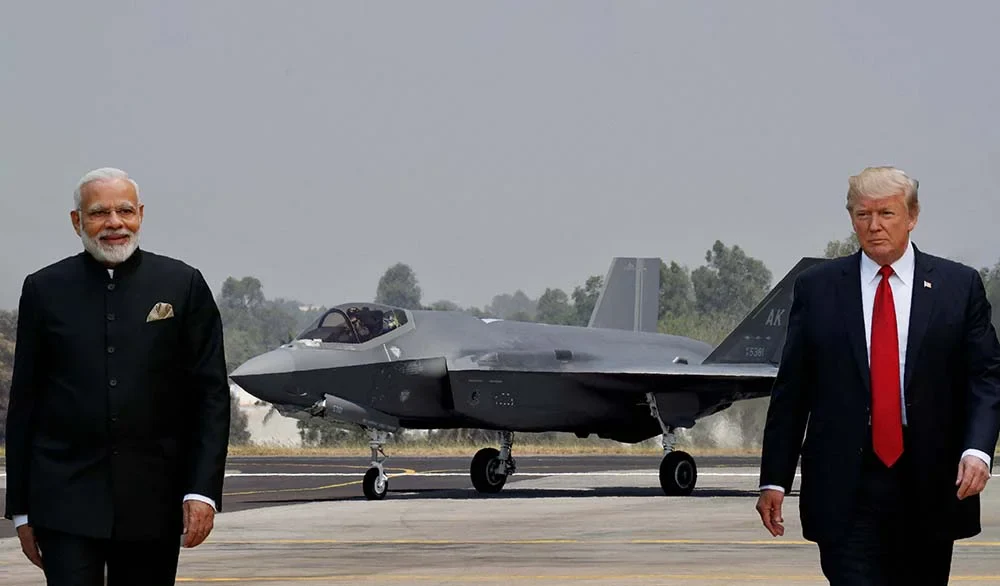
According to Karan Bhatta of Aviationa2z, the US government is taking a careful and strictly regulated approach to any possible talks about the F-35 Lightning-II stealth fighter plane for India.
The aircraft’s manufacturer, Lockheed Martin, recently made it clear that no private negotiations or direct business interaction are now occurring with New Delhi over this platform.
The manufacturer reaffirmed that government-to-government channels must be rigorously followed in all conversations pertaining to the F-35. The United States Foreign Military Sales framework, which guarantees the highest level of security and supervision for high-level defense exports, governs these exchanges.
Lockheed Martin affirmed that any communication between the company and India may only take place between the two countries’ independent governments. The Indian government is still the only body in charge of starting any official procurement requests or conversations with Washington under this arrangement.
The company emphasized that they don’t engage in independent or private discussions for the fifth-generation aircraft program. The F-35 Lightning-II cannot be sold or promoted through the same commercial channels as more traditional defense aircraft, which makes this distinction crucial.
The US government has complete control over all conversations pertaining to exports. The final say over approvals, final prices, and the conditions of any future discussions fall under this category. As a result, the corporate entity is unable to take action without explicit state approval.
Lockheed Martin declined to respond when asked if the Indian Ministry of Defense had sought for a formal product briefing. The fact that there is now no active corporate-level communication is further supported by the company’s decision to reroute all such inquiries back to the relevant governments.
This unwavering stance attests to the fact that Lockheed Martin and Indian defense authorities are not currently engaged in private conversations. Sensitive systems like the F-35 are kept under strict control by the FMS framework, which requires sovereign-level permission at every stage of a potential acquisition transaction.
India, for its part, is still concentrating its defense policy on modernizing its current fleet and fostering indigenous development. The foundation of New Delhi’s long-term airpower and technological policy continues to be the homegrown Advanced Medium Combat Aircraft program.
In order to maintain a high level of operational readiness, India is concurrently updating its fleet of 4.5-generation aircraft. There have been no official talks with the United States over the F-35, as Indian authorities have repeatedly affirmed in parliamentary comments.
This strategic approach is in line with Atmanirbhar Bharat, India’s larger focus on independence in military production. The country is putting more emphasis on improving its own capabilities over acquiring cutting-edge foreign stealth platforms right away.
The extremely stringent regulatory framework that oversees the F-35 program worldwide is highlighted by Lockheed Martin’s recent remarks. In contrast to many other military aircraft, the manufacturer does not actively sell the F-35 to overseas buyers in the conventional sense.
Rather, to guarantee that key systems continue to be subject to stringent political and security monitoring, the US government oversees every facet of involvement. Once a deal is negotiated at the highest levels of government, Lockheed Martin’s responsibility is mainly restricted to manufacturing and execution.
The program’s controlled character is highlighted by the company’s refusal to confirm or deny any casual outreach. They highlight the lack of open-market negotiations, which are common with less delicate military technology, by yielding to the state.
Lockheed Martin’s position does leave room for future possibilities, even though there aren’t any active conversations at the moment. In the event that India chooses to investigate the platform through formal government-to-government channels in the future, the business has not completely ruled out involvement.India’s foreign policy
The F-35 Lightning-II’s inclusion in a static display at Aero India 2025 is proof that interest in the aircraft is still high. This presence demonstrates the potential for high-end technological cooperation as well as the continued interest from other countries in the Indian defense sector.
Long-term strategic alignment and intricate geopolitical factors will be necessary for any future assessment of the F-35 by India. Changing procurement priorities rather than urgent operating needs would be the driving force behind any move toward the platform.