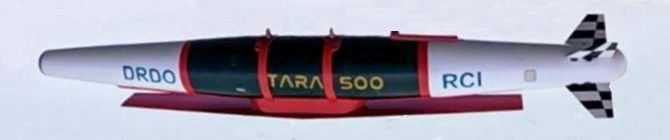
Tactical Advanced Range Augmentation (TARA) by the Defense Research and Development Organization is far more important than it seems. It is a reasonably inexpensive method for the Indian Air Force to transform current unguided gravity bombs into precision-guided stand-off weapons.
This is a significant force multiplier in contemporary air combat since it increases the lethality of outdated bomb stocks without requiring the purchase of costly new missile systemsTARA serves as a modular guidance and glide package that converts India’s substantial stockpiles of conventional gravity bombs into intelligent precision weapons. This strategy offers a number of significant benefits, including reduced strike costs, quicker mass manufacturing, and the capacity to maintain protracted hostilities. TARA guarantees that India can sustain high-volume precision strike capabilities without depleting its missile reserves, since precision weapons are quickly depleted during conflicts.Research reports from DRDO
.The stand-off assault capacity of TARA is one of its most significant aspects. Aircraft cannot always fly straight over targets, and modern air defense systems are becoming more and more deadly. As the weapon glides toward its target, aircraft like the Jaguar and Su-30MKI, as well as possibly TEJAS and Rafale in future integrations, can deliver bombs from safer distances thanks to TARA. This raises mission success rates and increases pilot survivability.
After being released, the system uses electro-optical seekers, GPS-assisted guidance, and inertial navigation to deploy wings and tail units. It can attain accuracy levels of less than five meters, with some experiments achieving even closer precision.
Up till now, India has relied on imported precision kits like HAMMER and SPICE 2000. TARA, which was created to complete many of the same striking missions at a significantly lower cost, is basically India’s domestic version.
Its concept has been directly compared by analysts to SPICE glide bombs, although the domestic system has the advantage of lowering reliance on foreign sources. TARA is being manufactured in 250 kg, 450 kg, and 500 kg configurations with a range of 150–180 km when released from altitude. It was developed by Research Centre Imarat in Hyderabad with assistance from other DRDO laboratories and Indian industrial partners. Under the Development-cum-Production Partner model, production activities have already started, guaranteeing scalability and quick induction.
Situations involving China and Pakistan highlight TARA’s strategic significance. For deep strike capability, runway attacks, bunker demolition, and suppression of enemy air defenses, the IAF needs high-volume precise strikes against both enemies.
While more costly systems like BrahMos and SCALP are kept for high-value targets, TARA may become one of the “mass use” precision weapons for such operations. In this regard, TARA is best viewed as a “workhorse smart bomb” that enhances India’s superior attack capabilities.
The creation of reasonably priced precision glide bombs has emerged as a key development in contemporary warfare on a global scale. China uses the LS-6 series, Israel uses SPICE, Russia has created UMPK glide kits, and the United States uses JDAM-ER kits.
India’s TARA entry into this category demonstrates its commitment to pursue self-reliance under the Aatmanirbhar Bharat plan while keeping up with international military innovation. One of TARA’s biggest advantages is its capacity to manufacture such weapons in extremely large quantities, since wartime situations require thousands of precision weapons rather than a few hundred high-end missiles.Indian cultural excursions
In the end, TARA marks a significant advancement in India’s defense modernization. It lowers expenses and reliance on foreign equipment while improving the IAF’s lethality, survivability, and operational flexibility.
India has positioned itself to sustain protracted confrontations with a strong arsenal of precision-guided glide bombs by fusing indigenous ingenuity with industrial scalability, guaranteeing that its airpower remains competitive in the changing terrain of contemporary combat.