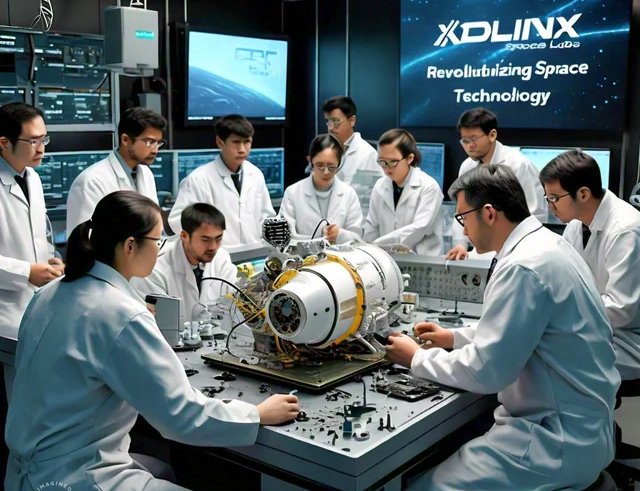
ISRO Chairman Dr. V Narayanan attended the opening of XDLINX Space Labs’ Advanced Space Systems Integration and Testing Lab in Hyderabad on May 2, 2026.
The facility supports tiny and microsatellite platforms and supports the Atmanirbhar program, strengthening India’s independent satellite infrastructureWith the opening of its new Advanced Space Systems Integration and Testing Lab, XDLINX Space Labs achieved a significant milestone. Senior officials from the Indian Space Research Organization (ISRO), including Dr. V Narayanan, Chairman of ISRO and Secretary of the Department of Space, attended the inauguration.
During his visit, he was given a thorough overview of XDLINX’s current satellite programs as well as visits of subsystem laboratories devoted to mechanical systems, radio frequency communications, and mission operations.
.Next-generation tiny and microsatellite platforms are supported by the facility’s design. Its technical capabilities include an electrical power systems (EPS) test lab for battery qualification and power distribution modeling, a dedicated Attitude Determination and Control System (ADCS) lab with a high-accuracy air bearing platform and Helmholtz coil for magnetic field simulation, and precision optical benches that can handle payloads with apertures up to 450 mm.
The focal point is a top-notch cleanroom setting for the final assembly of satellites weighing between 10 and 300 kg, guaranteeing mission dependability and adherence to global standards.
The Atmanirbhar Bharat plan in India, which requires private sector to produce 75% indigenous subsystems for both domestic and international missions, is strongly related to this expansion. Within the next two years, XDLINX is contracted to provide a sovereign constellation of fifteen satellites, and it has already created five satellite bus platforms.
Dr. Narayanan emphasized the importance of private sector contributions to India’s space ecosystem, especially when it comes to removing obstacles to entrance like internal testing capabilities for high-reliability missions.
The business is getting ready for a number of impending mission milestones. XDLINX is completing the Elevation-1 project, which includes a miniature space-grade E-band payload for high-speed communications, after the JANUS-1 nanosatellite was launched successfully.
A 190 kg-class satellite with a multi-spectral optical and Synthetic Aperture Radar (SAR) payload that is slated for launch on a SpaceX Transporter mission in late 2026 will also be integrated into the new facility. This mission highlights XDLINX’s expanding position in advanced payload integration and multinational launch partnerships.
Beyond these current initiatives, XDLINX has been growing its capabilities and collaborations. In order to promote sustainable space operations, the company has formed partnerships like a Memorandum of Understanding with Japan’s BULL Co., Ltd. and inked a deal in December 2025 to locate its satellite R&D center at GMR Aerospace Park in Hyderabad.
Additionally, it has demonstrated its desire to lead the way in developing new Earth observation technologies by collaborating with Sisir Radar to build India’s first private L-Band SAR satellite. These programs support the company’s overarching plan to commercialize deep space technologies and provide ready-to-launch satellite platforms for international missions.
An important step toward expanding India’s independent space infrastructure is the opening of the Advanced Space Systems Integration and Testing Lab. XDLINX is establishing itself as a crucial private sector participant in India’s developing space ecosystem by fusing domestic subsystem development with cutting-edge testing skills, boosting both domestic independence and global competitiveness.

