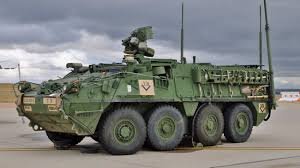
Due to the US-made Stryker armored vehicle’s inability to meet crucial operational criteria, especially amphibious capability, the Indian Army decided to forgo plans to purchase it in favor of indigenous alternatives like the Wheeled Armoured Platform (WhAP).
This action is in line with India’s larger focus on defense independence and equipment customization to local conditions and military requirements.
The Indian Army has previously engaged in negotiations to purchase the American Stryker armored vehicle, but these negotiations have now been put on hold. According to defense sources, the Stryker program was canceled because it was thought to be inappropriate for Indian operating circumstances.
In line with India’s strategic aim for self-reliance in defense procurement, the move represents a substantial shift towards domestic alternatives.
The Indian Army’s stringent need for amphibious capability was a major contributing factor to the rejection. Without the assistance of combat engineers, wheeled Infantry Combat Vehicles (ICVs) must be able to cross rivers and canals on their own.
The Stryker is inappropriate for India’s different operating conditions, especially in areas like Ladakh where mobility across varied terrain is crucial, even though it has been demonstrated in other theaters.
The Indian Army’s stringent need for amphibious capability was a major contributing factor to the rejection. Without the assistance of combat engineers, wheeled Infantry Combat Vehicles (ICVs) must be able to cross rivers and canals on their own.
The Stryker is inappropriate for India’s different operating conditions, especially in areas like Ladakh where mobility across varied terrain is crucial, even though it has been demonstrated in other theaters.
Another factor was operational constraints. The Army determined that the Stryker’s performance and design were incompatible with Indian conditions, such as the requirement for adaptable maneuverability and high-altitude deployment. The decision to back out of the contract was further supported by this lack of appropriateness, which decreased operational interest in the platform.
Rather, military strategists are currently concentrating on the domestic Wheeled Armoured Platform (WhAP), which was created in collaboration between Tata Motors and the Defence Research and Development Organization (DRDO).
The WhAP is a more sensible option for upcoming ICV fleets because of its amphibious capability and adaptation to Indian terrain. By giving domestic solutions priority, this action not only meets operational needs but also fortifies India’s defense industry base.
India’s larger strategic focus on Atmanirbhar Bharat (Self-Reliant India) in defense is shown by the cancelation of the Stryker agreement. The Army is indicating that it intends to invest in domestic technologies that may be tailored to local conditions by rejecting international platforms that do not satisfy particular operational requirements.
Additionally, this strategy improves long-term sustainability in the development of defense capabilities and lessens reliance on outside sources.Military equipment retailer
In conclusion, the Indian Army’s decision to drop the Stryker program was motivated by both a strategic preference for domestic solutions and operational unsuitability, specifically the lack of amphibious capability.
The WhAP, which reflects both practical battlefield requirements and national defense priorities, is currently the cornerstone of India’s future wheeled ICV fleet.

