The Indian Army has started a major mobility upgrade after the Akashteer air defense command and control system was decisively successful during Operation Sindoor last year.
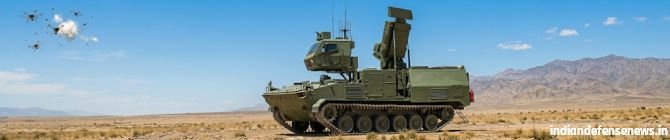
In order to improve cross-country mobility and keep up with armored formations during maneuvers, plans are ongoing to incorporate Akashteer systems onto tracked armoured vehicles.
This is a change from the existing truck-mounted setup, which is mobility but has less protection and terrain adaptability than armored platforms.Indian cultural excursions
For the purchase of 83 locally produced Carrier Air Defence Tracked (CADET) systems, the Ministry of Defence has released a request for proposals. In order to provide self-propelled gun and missile units in mechanized formations with real-time air defense control and reporting, these tracked platforms will be equipped with Akashteer equipmenThe Army Air Defense’s need for a shared tracked platform that can transport both present and future equipment to assist mechanized forces is highlighted in the RFP. In order to provide a consistent operating picture across formations, the CADET will be connected with the latest generation connected Battlefield Management System and Identification of Friend or Foe technologies.
tProtecting field formations in tactical fighting areas and offering point defense to static establishments are the responsibilities of the Army Air Defense, a combat support arm. It now uses fixed weapon systems in addition to a combination of wheeled and tracked self-propelled units.
Although truck-mounted Akashteer units provide mobility and quick redeployment, their shortcomings in terms of survivability and cross-country mobilityThe operational significance of tracked platforms is demonstrated by the Army’s current use of modified BMP armored fighting vehicles for command posts, radar carriers, and specialized missions.
have led to the switch to tracked carriers.Field commanders need highly mobile air defense control and reporting capabilities because they provide operational flexibility and real-time situational knowledge. Commanders can react quickly to threats in their immediate area by lowering reliance on rear echelons and shortening the sensor-to-shooter loop.
The core of Army Air Defense is a fully automated network of radars and sensors called Akashteer, which was created by Bharat Electronics Limited. Its near-perfect detection and interception rates against Pakistani drones and missiles during Operation Sindoor validated its efficacy in real-time warfare.
As a component of India’s larger C4ISR framework, Akashteer is easily integrated with the Navy’s Trigun air defense network and the Indian Air Force’s Integrated Air Command and Control System. Precise, coordinated offensive and defensive operations are made possible by this tri-service integration, which also improves situational awareness.
The CADET platform is designed to be a powerful tracked chassis with enough internal room to hold a minimum of five crew members, their personal weapons, and technical parts. Additionally, it will have exterior attachment points for a variety of buildings and equipmenAkashteer components, drone detection and interdiction systems, drone kill systems, and vehicle-mounted counter-swarm drone systems are among the equipment that will be integrated into CADET. This demonstrates the Army’s awareness of the increasing threat posed by drones and the requirement for multi-layered counter-UAS capabilities.
A variety of environments, including plains, deserts, semi-deserts, and high-altitude regions up to 16,000 feet, will see the deployment of CADET platforms. With day-night operability and navigational aids to facilitate cross-country travel, they are built to function in extremely cold temperatures, from minus thirty to fifty degrees Celsius.
By guaranteeing that air defense assets can maneuver alongside mechanized formations and stay resilient in disputed areas, this strategy is in line with the Army’s larger modernization drive.
The Army is improving its capacity to neutralize aerial threats in real time while maintaining combat tempo by combining the mobility and protection of tracked vehicles with Akashteer’s proven command and control capabilities.
Additionally, the CADET initiative highlights India’s focus on domestic defense production, bolstering technological innovation and self-sufficiency in vital combat systems.
t.
.