According to FirstPost, a Pakistani cleric named Maulana Nasir Madni has asserted that Hafiz Saeed, the founder of Lashkar-e-Taiba (LeT), sent over 10,000 young men to fight in Kashmir. This claim has rekindled discussion about militant recruitment in Pakistan and India’s long-standing accusations against Saeed.
Despite Saeed’s incarceration, his comments during a gathering in Bahawalpur directly connect him to cross-border militant activity.
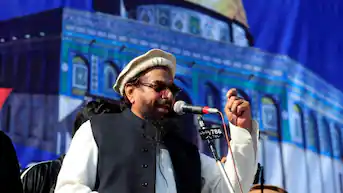
The Pakistan Markazi Muslim League (PMML), a political organization with ties to LeT, organized the rally where Madni gave her statement. He lauded Saeed as a national hero in a widely shared video, saying that Saeed had “presented 10,000 youths for Kashmir and for the sacrifice of the motherland.”
He called these individuals “commandos” and asked why they hadn’t spoken anything while Saeed was incarcerated. Although the video’s veracity has not been independently confirmed, the comments have garnered a lot of attention.
The cleric’s remarks are consistent with India’s long-standing allegations that Saeed and LeT have enlisted, trained, and enabled militants to carry out strikes against India. Saeed created Jamaat-ud-Dawa (JuD) after co-founding LeT.
Both the United States and the United Nations have declared him a terrorist, and Washington is offering a $10 million reward for information that leads to his conviction. Major terror acts, like as the 2008 Mumbai attacks, have frequently been connected to his name.
Madni’s comments are noteworthy for their timing. Saeed was named as a major suspect in the April 2025 Pahalgam terror incident, which claimed 26 lives, according to a chargesheet filed by India’s National Investigation Agency (NIA) on July 6, 2026.
According to the Unlawful Activities (Prevention) Act, the NIA charged Saeed and LeT with plotting to wage war against India. A non-bailable warrant was then issued against him by a special NIA court, demonstrating India’s resolve to hold him accountable despite his incarceration in Pakistan.
Madni’s comments are noteworthy for their timing. Saeed was named as a major suspect in the April 2025 Pahalgam terror incident, which claimed 26 lives, according to a chargesheet filed by India’s National Investigation Agency (NIA) on July 6, 2026.
Madni’s comments are noteworthy for their timing. Saeed was named as a major suspect in the April 2025 Pahalgam terror incident, which claimed 26 lives, according to a chargesheet filed by India’s National Investigation Agency (NIA) on July 6, 2026.
According to the Unlawful Activities (Prevention) Act, the NIA charged Saeed and LeT with plotting to wage war against India. A non-bailable warrant was then issued against him by a special NIA court, demonstrating India’s resolve to hold him accountable despite his incarceration in Pakistan.
Even though the 10,000 figure cannot be independently verified, analysts point out that the remark itself is noteworthy because it officially admits extremist recruitment activities that Pakistan has frequently attempted to minimize.
The assertion also coincides with increased scrutiny of Pakistan’s extremist environment. LeT’s attempts to rebuild infrastructure in Pakistan-occupied Kashmir, including training camps and launch pads close to the Line of Control, have been frequently warned about by Indian intelligence. Concerns that extremist networks are still strong and a threat to regional stability are strengthened by Madni’s comments.
Madni’s comments are noteworthy for their timing. Saeed was named as a major suspect in the April 2025 Pahalgam terror incident, which claimed 26 lives, according to a chargesheet filed by India’s National Investigation Agency (NIA) on July 6, 2026.
According to the Unlawful Activities (Prevention) Act, the NIA charged Saeed and LeT with plotting to wage war against India. A non-bailable warrant was then issued against him by a special NIA court, demonstrating India’s resolve to hold him accountable despite his incarceration in Pakistan.
The cleric’s remarks support India’s claim that Pakistan has not destroyed LeT’s ability to conduct operations. The degree of Saeed’s power and the veracity of Pakistan’s assertions that he is only a prisoner serving terms for financial crimes are called into question.
The wider consequence is that terrorist networks are still capable of regenerating and maintaining cross-border operations in spite of leadership losses.